Kingda pump group
Split Case Pump
Kingda double suction split case pump prioritizes reliability, with lower bearing loads, effectively extending service life and minimizing user operating costs.
The axial split case and modular design simplify maintenance, save operator time, and accelerate production.
The split case pump boasts excellent efficiency and is widely used in high-flow-rate applications such as municipal water supply, fire protection, HVAC, and industrial water treatment. Kingda ensures users can efficiently utilize the pump in demanding applications.
What is a Split Case Pump?
Split Case Pump Definition
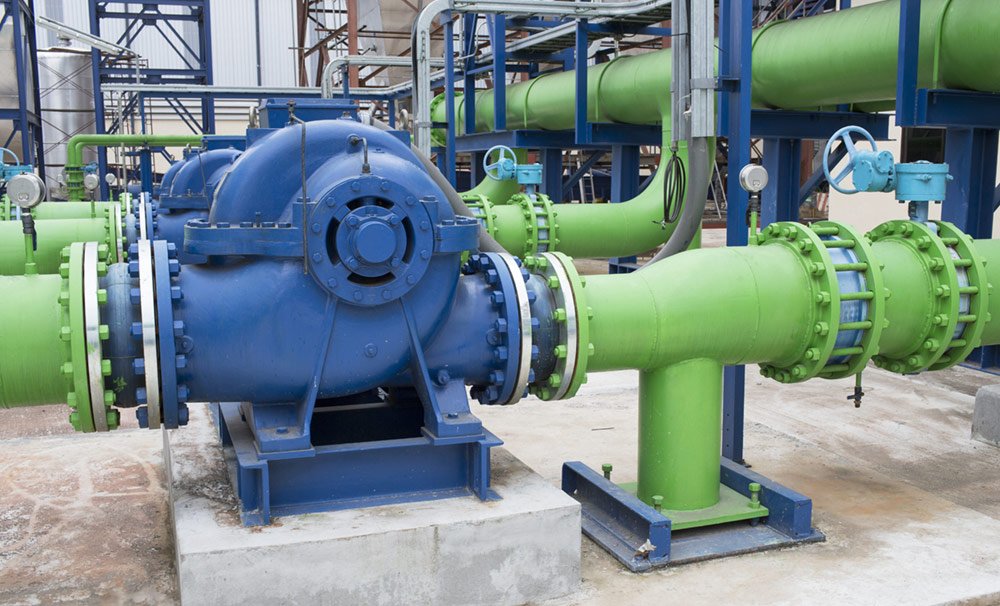
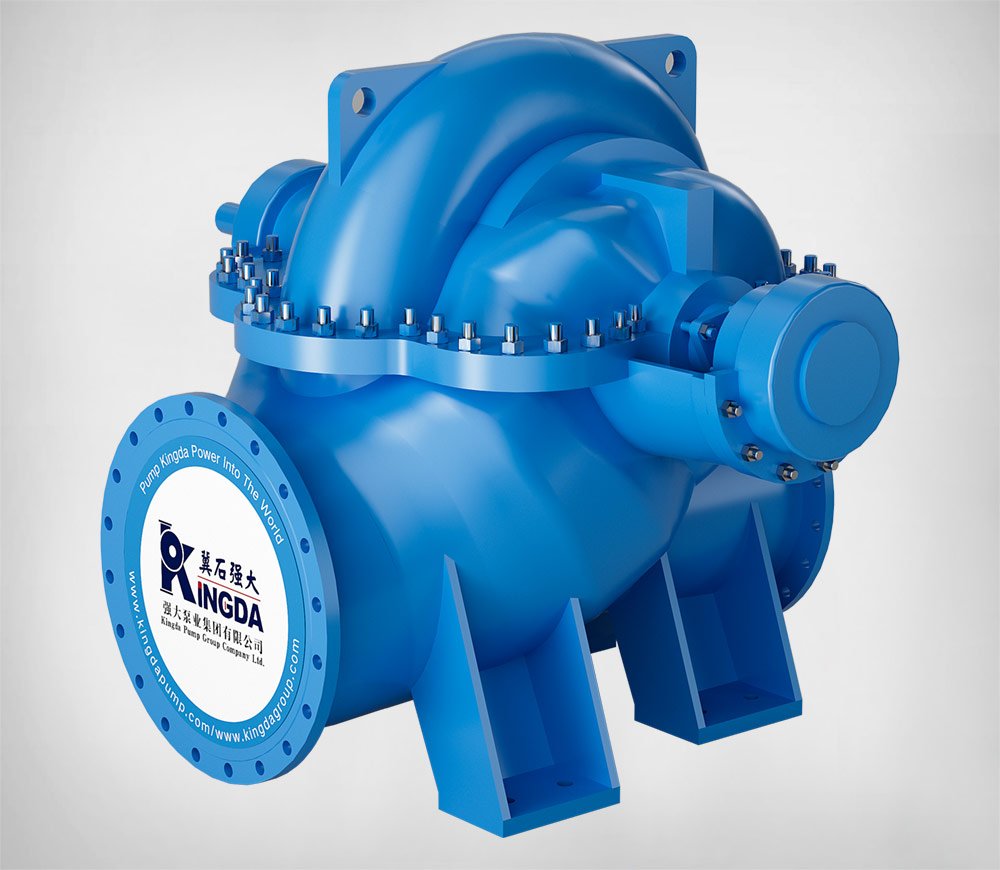
A split-case pump is a horizontal, single-stage, double-suction centrifugal pump, typically consisting of two parts, horizontally or vertically, centered on the axial direction.
The double-suction structure of the split-case pump balances hydraulic impact, reduces axial thrust, and effectively extends the pump’s service life.
Due to its high flow rate and durability, it is widely used in water supply systems, fire protection, HVAC, and irrigation systems, effectively improving work efficiency.
Split Case Pump Working Principle
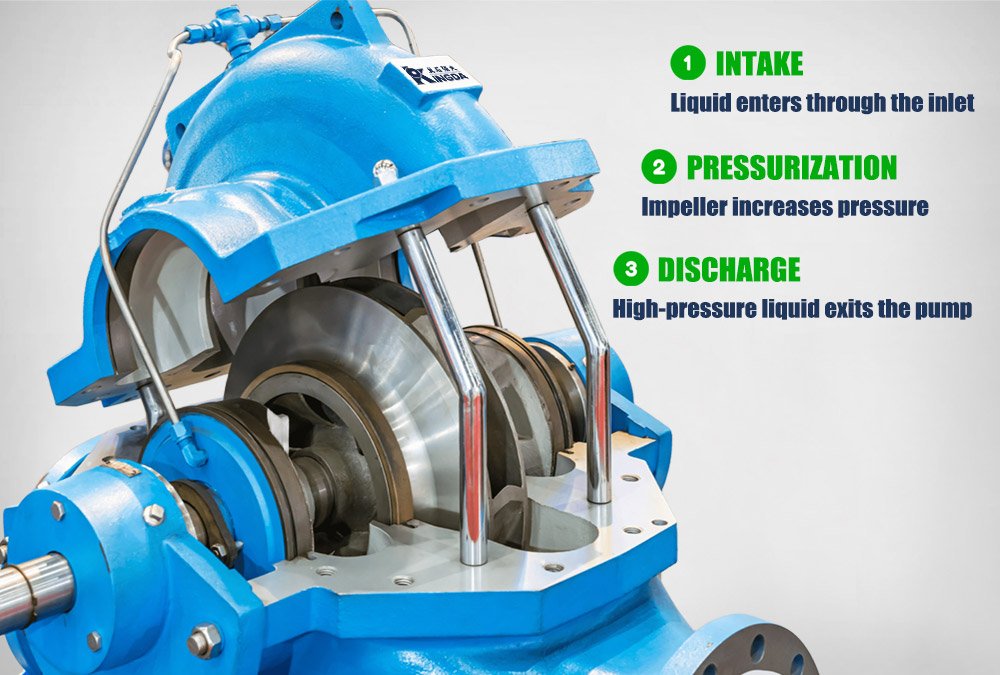
Split-case pumps, like most centrifugal pumps, operate on a similar principle
Intake: After startup, the impeller rotates, and liquid enters the pump casing through the inlet.
Pressurization: As the impeller rotates, the liquid inside the casing is thrown outwards. As the liquid moves, its kinetic energy is converted into pressure energy.
Discharge: The liquid pressure within the pump casing continuously increases, waiting to reach the outlet. Finally, the liquid is discharged from the pump at high pressure.
Horizontal Split Case Pump Specification
🔸Discharge Diameter(mm): 300 ~ 1000
🔸Capability(m³/h): 1000 ~ 18000
🔸Head(m): 22 ~ 170
🔸Motor: 4 ~ 2500
🔸Material: Ductile iron, Steel, Copper, High chromium alloy
🔸Sealing: Packing seal, Mechanical seal
Benefits of Split Case Pump
Split Case Pump Design
Double Suction: The double suction split case pump features a double suction impeller design that balances the impact of hydraulic pressure on the pump after liquid enters, reducing the load on the bearings, effectively reducing maintenance frequency, and extending service life.
Axial Split Casing: The axial split casing pump makes maintenance more convenient. The casing can be split horizontally or vertically. During maintenance, only the pump cover needs to be removed to access components such as the impeller and bearings, without disassembling water pipes, couplings, and the motor.
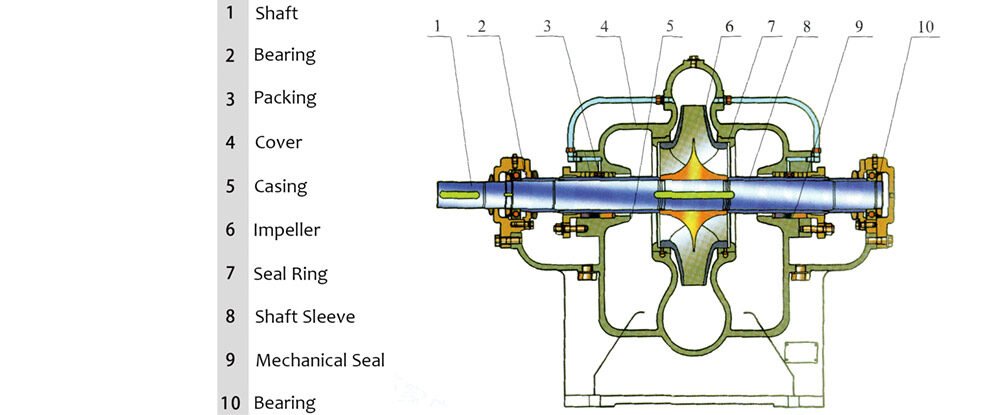
Horizontal Split Case Pump Diagram
Why Choose Kingda Double Suction Horizontal Split Case Pump
High Efficiency
Engineers optimized the flow channel and impeller, and performed stress analysis on internal components, significantly reducing hydraulic losses and effectively improving efficiency.
Long Service Life
The split case pump impeller and easily worn parts are made of ultra-high wear-resistant and corrosion-resistant alloy materials, meaning it can meet the needs of users for long-term use in harsh conditions.
Modular Design
Kingda engineers designed the split case pump with modular components, which not only simplifies maintenance but also effectively reduces user operating costs.
Easy Maintenance
Engineers optimized the top wall thickness of the pump body, releasing internal stress and making the pump structure more compact while ensuring robustness and durability. Combined with the split pump casing design, maintenance becomes even simpler.
Intelligent Monitoring
Kingda's newly developed remote intelligent monitoring system can monitor the pump's operating status in real time. It promptly notifies users when data such as flow rate and head change, preventing malfunctions and minimizing user losses.
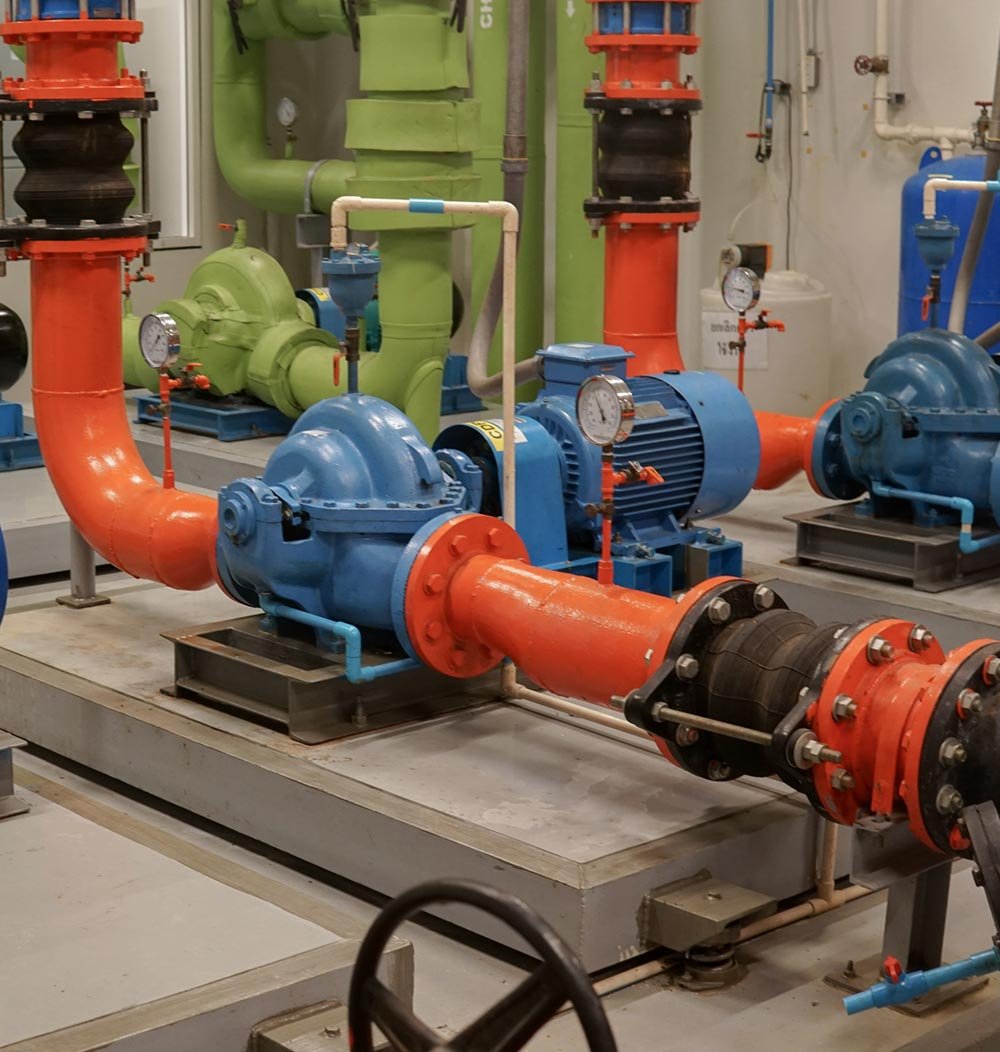
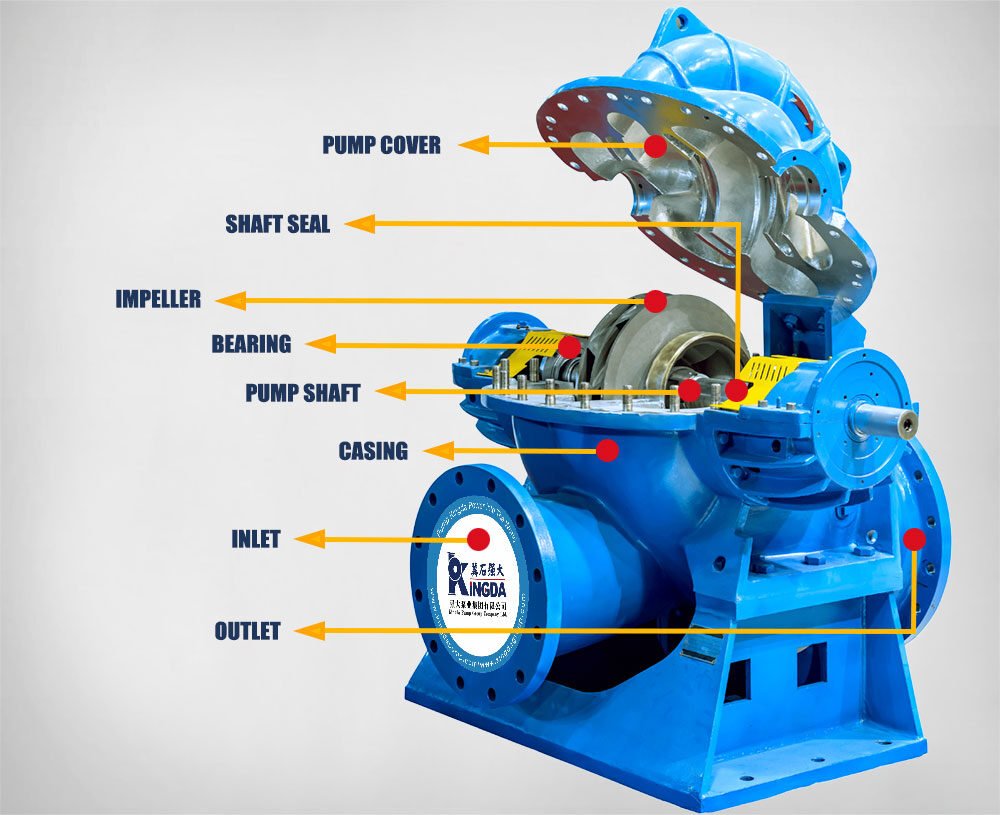
Split-Cast Pump Impeller: The impeller is a rotating component mounted on the pump shaft to move the liquid. A double-suction impeller can balance the hydraulic pressure, reduce the bearing load, and extend the pump’s service life.
Axial Split Casing: The pump casing is the container holding the internal components of the pump. An axial split casing simplifies maintenance; maintenance can be performed by disassembling only half of the casing without disassembling other parts.
Shaft: The pump shaft connects the motor and the impeller. The motor transmits mechanical energy to the impeller through the pump shaft, causing the impeller to rotate and supporting its stable operation.
Bearing: Bearings support the rotation of the pump shaft and reduce friction during rotation, improving pump stability.
Seal: Seals prevent leakage of the pumped liquid, which could damage the pump. Common sealing methods include packing seals and mechanical seals.
Searching for a high-performance split case pump?
Email us at info@kingdagroup.com for expert support and fast pricing.
Split Case Pump Applications
Municipal Water Supply
In large-scale water supply systems, high-flow, stable pumping equipment is often required, making split case pumps an ideal choice.
HVAC
In HVAC systems, split case pumps are commonly used to flush pipes of scale, metal filings, and other impurities, improving air conditioning efficiency.
Fire Protection
In fire protection systems, split case pumps can quickly and efficiently deliver water to fire protection pipelines, even in high-rise buildings.
Industrial Water Treatment
In industrial projects such as oil and power plants, split case pumps can be used as cooling and water circulation pumps.
Irrigation
In large-scale irrigation projects, double suction split case pumps can efficiently and stably deliver water, significantly reducing operating costs.
Marine Engineering
On ships, split case pumps can be used as high-pressure flushing pumps to flush away silt and remove sediment.

Proven Performance in Real Projects
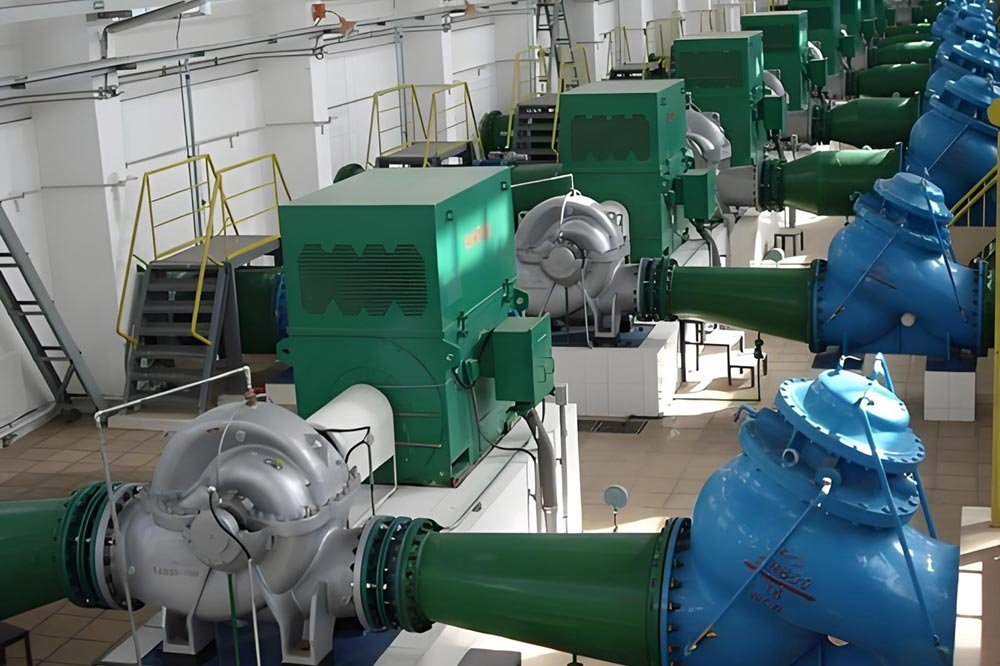
This project, located in a large power plant in China, utilized the SXK250 split-case pump in the power plant’s circulating water system.
This improved the unit’s power generation efficiency and significantly reduced the power plant’s energy consumption.
Power Plant Circulating Water Pump
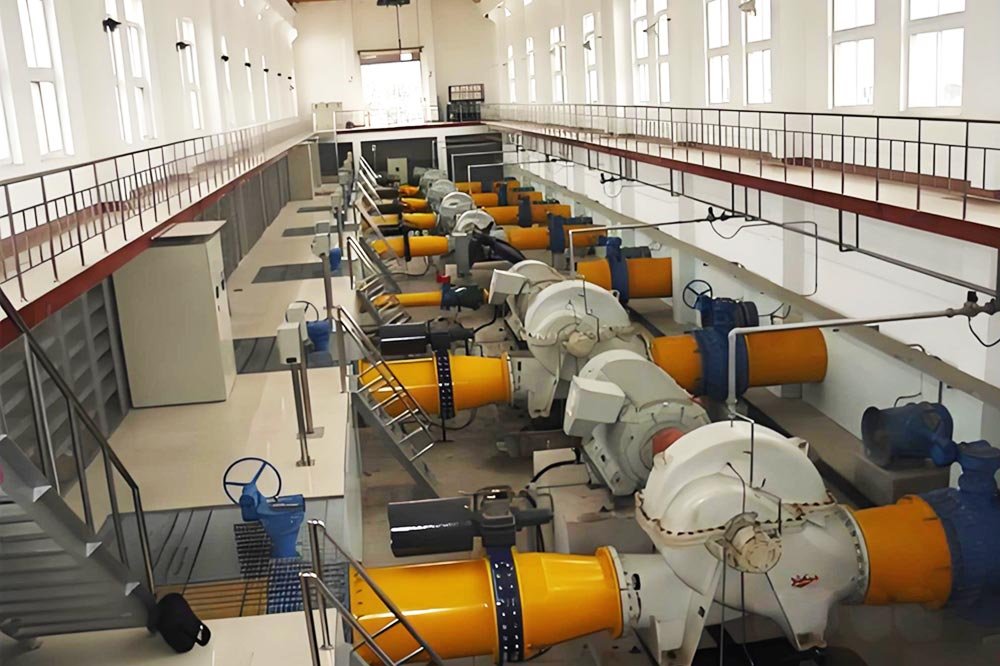
In this project, a large waterworks required a water supply capacity of 300,000 tons per day. This necessitates extremely high flow rates and continuous operation.
The SXK split-case pump undoubtedly performed admirably.
Water Plant Supply System
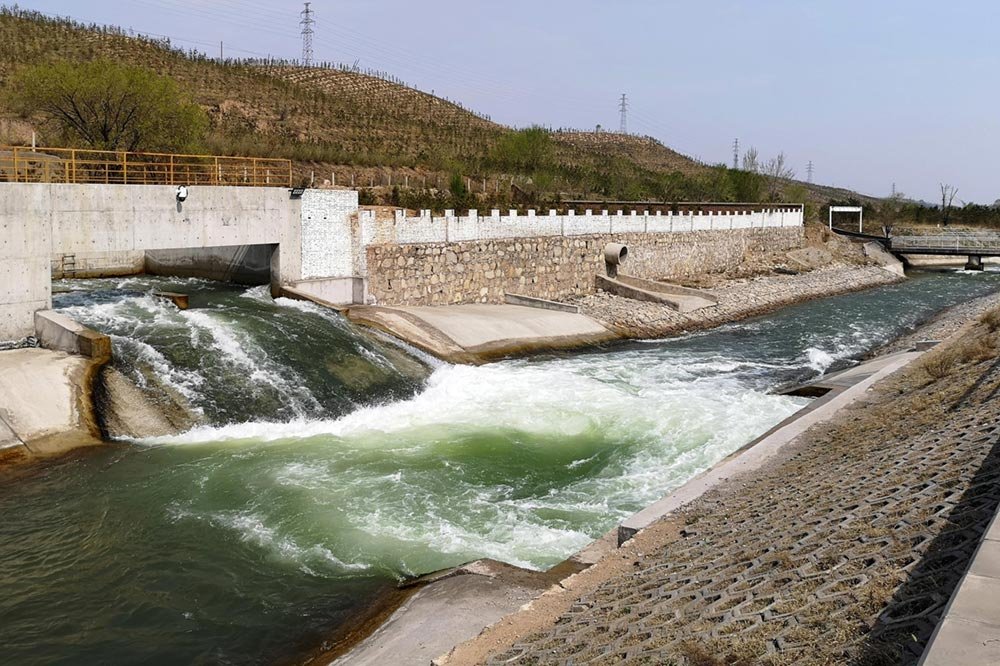
This is a government-led mega-scale water diversion project located in Shanxi Province, China. It involves diverting water from rivers over long distances to arid regions.
This not only requires extremely high flow rates but also a long-term, stable water supply.
Large-Scale Water Diversion Project
Types of Split Case Pump
Horizontal Split Case Pump
The horizontal split case pump is the most common type. The pump casing is divided into upper and lower parts with the pump shaft as the horizontal line, making it easier to maintain and care for.
Vertical Split Case Pump
A vertical split case pump has a pump casing that is split vertically in the middle. Vertical pumps can be used in projects with strict space requirements, and they are more space-saving.
Vertical VS Horizontal Split Case Pump
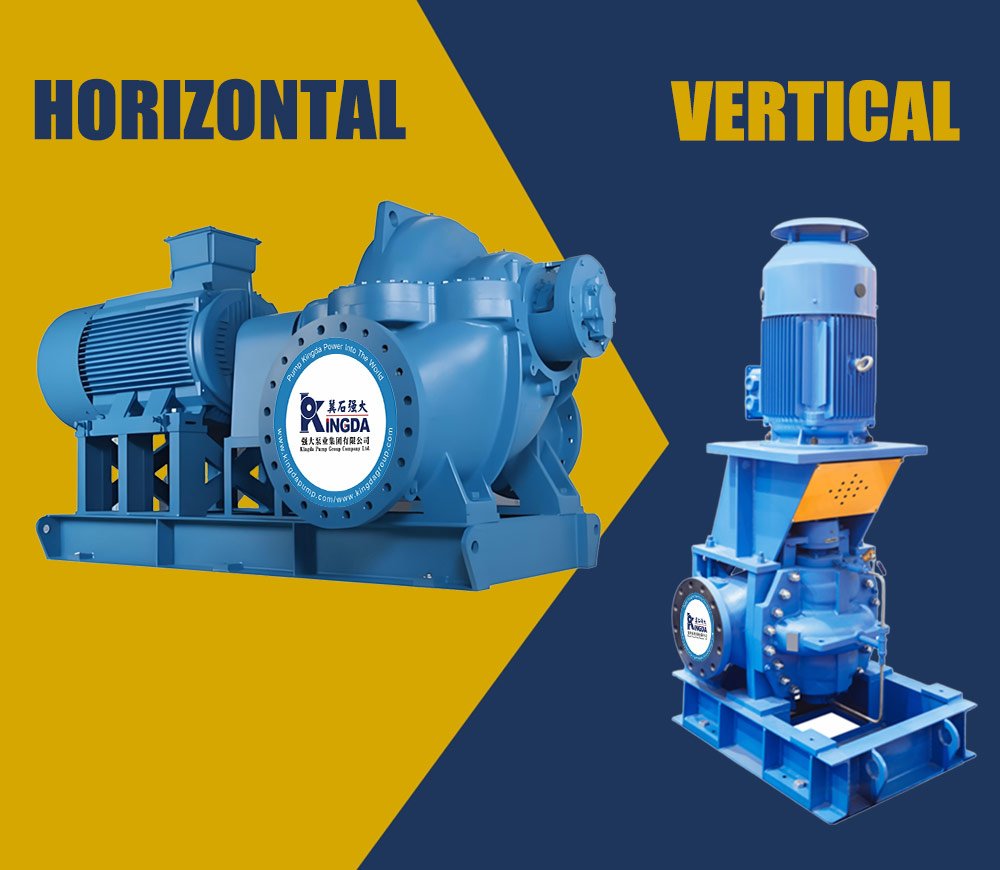
Vertical and horizontal split-case pumps are both centrifugal pumps and operate on the same principle. Their biggest difference lies in their structure: vertical split-case pumps separate vertically, while horizontal split-case pumps separate horizontally.
When choosing a split-case pump, the primary consideration is the availability of installation space. If space is ample, a horizontal structure is recommended, while a vertical structure is suitable for workstations with limited space.
Looking for a reliable split case pump solution?
Get expert advice and a fast quote — contact us at info@kingdagroup.com
Horizontal Split Case Pump Installation And Maintenance
Horizontal Split Case Pump Assembly And Installation Detail
The pump unit should be installed on a solid foundation. These foundations must be equipped with anchor bolts. The pump should only be put into operation after the cement grout has completely hardened. A solid foundation is essential for the pump; easily deformable foundations are unacceptable.
Pump Installation
- Place the pump on the concrete foundation with embedded anchor bolts, and adjust the pump shaft to be level. Tighten the anchor bolt nuts appropriately to prevent movement.
- Place the motor, align the motor shaft with the pump shaft, and ensure both shafts are in a straight line, leaving a certain end face clearance between the pump and motor coupling.
- Check the installation accuracy. Measure the clearance between the coupling planes at several opposite positions using a feeler gauge.
Split Case Pump Maintenance
Daily:
- Check for leaks, vibration, and noise. Check the pressure gauge’s operation.
Weekly:
- Shaft seals: Leakage must be sufficient to cool and lubricate the packing and bushing.
- Bearing temperature: Place a contact thermometer on the bearing housing to measure the bearing temperature. Under normal circumstances, the temperature should not exceed 100°C.
Every Year:
- Check bearings: Clean any residual grease or lubricating oil from the bearings and bearing housing. Clean all components with clean alcohol or acid-free kerosene, and replace with new grease or lubricating oil.
- Grease lubrication: Under normal circumstances, the bearing temperature should not exceed 100°C. Grease aging is accelerated when the temperature exceeds 70°C.
A Reliable Split Case Pump Supplier
As one of the leading horizontal split case pump manufacturers in China, we have been designing and manufacturing water pumps since 1948, and undoubtedly possess extensive manufacturing experience.
We firmly believe that with our rich experience and strong capabilities, we can meet our users’ stringent conveying requirements. Our engineers will design the most comprehensive conveying solution based on your project background, minimizing your costs.
We also have a reliable and knowledgeable maintenance team. When your water pumps encounter problems, they will provide you with specific and feasible solutions as quickly as possible, reducing your downtime and improving work efficiency.
Split Case Pump Spare Parts
| Wet End Wear Parts | Bearing Parts | Shaft Seal Parts | Other Parts |
|---|---|---|---|
| | |||
| | | ||
| | | ||
| | | | |
| | | | |
| | | |
FAQ
Under normal circumstances, split case pumps are not suitable for conveying ultra-high temperature fluids. It is recommended that the fluid temperature not exceed 80 degrees Celsius, as excessively high temperatures can easily damage pump parts and ultimately lead to pump failure.
For conveying ultra-high temperature fluids, it is recommended to contact the pump manufacturer to customize a dedicated pump based on the physical properties of the fluid.
Split case and end suction pumps both belong to the centrifugal pump family and operate on the same principle, differing mainly in their structure.
End suction pumps are typically single-stage, single-suction centrifugal pumps. During operation, liquid enters through the inlet and exits through the outlet, with the inlet and outlet angles usually at 90 degrees.
Split case pumps are double-suction centrifugal pumps. The pump's suction and discharge inlets are located on the same horizontal line. This double-suction structure balances the hydraulic forces, reduces bearing load, and extends service life.
Before starting the unit, the entire unit must be inspected. If any foreign matter has entered, the water pump should be flushed.
- Thoroughly inspect the entire unit.
- Ensure all bolts are tightened.
- Verify the motor's power connection is correct.
- Verify the power supply voltage is correct.
- Open the inlet valve and close the outlet valve.
- Install a pressure gauge and vacuum gauge on the water pump.
- Ensure the pump shaft and motor shaft are aligned.
- Apply lubricating oil (grease) to the bearings.
- Shaft seal; the pump shaft should rotate easily.
- Check that the water pump and suction pipe are full of water.
- Check the flushing water connection of the sealing device. If the flushing water is supplied by an external system, connect the flushing water before starting the unit.
Note: When checking the rotation direction of the motor and water pump, the motor and pump must be checked separately. Dry rubbing of the sealing surfaces is prohibited; otherwise, the seal will immediately fail.
Get free pump selection tips from Kingda experts.
Kingda is committed to providing the best fluid transfer solutions.
Contact Kingda for a free quote, pump selection, engineering advice, and pump maintenance tips.