In both residential and industrial settings, sump pumps or sewage pumps are essential for treating wastewater and sewage. You may have many questions about these two types of pumps, and what are the differences between them?
This guide aims to resolve your doubts and answer questions when choosing a pump. You can learn the following in this guide:
- Key Differences
- Explanation of Sump Pump & Sewage Pump
- How to Choose
- Maintenance and Costs
- More Questions About Sump Pump
Sewage Pump vs Sump Pump: Key Differences
Difference Between Sump Pump and Sewage Pump
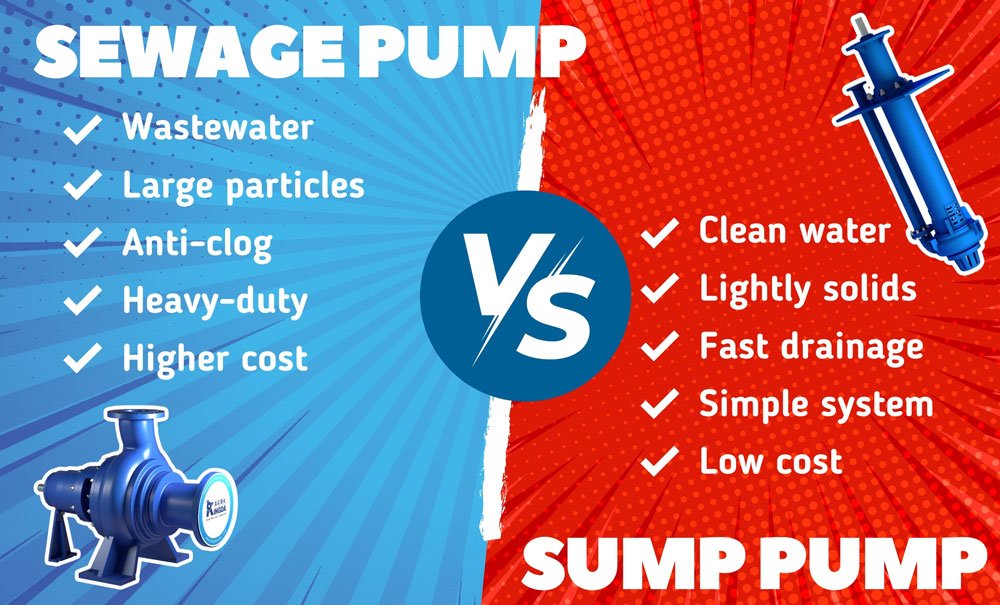
Sump pumps and sewage pumps have different functions.
Sump pumps are mainly used to treat sump water in basements and rainwater, which usually does not contain solid particles. Sewage pumps (or sewage ejector pumps) are used to treat sewage containing solids and impurities, such as toilet waste, underground sewage pipes, and septic tanks.
Comparison Table
| Key Differences | Sump Pump | Sewage Pump |
| Purpose | Sump pumps are used to transport light sewage such as basement water and rainwater. | Sewage pumps are used to transport domestic sewage containing solids, septic tanks, etc. |
| Fluid Type | Groundwater, rainwater, and lightly polluted water. | Domestic sewage and industrial wastewater. |
| Solids Handling Capacity | Wastewater with fine particles or almost no particles. | Wastewater containing solid particles, impurities, and fibers. |
| Pump Design | Narrow flow channels, high efficiency, and impassable for large solid particles. | Wide flow channels, non-clogging design, can pass through large solid particles. |
| Maintenance Needs | Maintenance is infrequent, mainly involving the removal of sediment. | Frequent maintenance is required, primarily checking for impeller wear and blockage. |
What Is a Sump Pump?
A sump pump is a drainage device installed in basements, sump pits, and reservoirs to prevent equipment damage or flooding caused by waterlogging and dampness. It is typically installed in a low-lying area and automatically drains rainwater, sewage, and stagnant water via a float switch, maintaining the water level within a safe range.
What is a sump pump used for?
Sump pumps are primarily used for draining sump pits, reservoirs, basements, or low-lying areas to prevent flooding caused by excessively high water levels or damage to buildings due to dampness.
- Sump pit drainage
- Basement drainage
- Construction site drainage
- Reservoir drainage
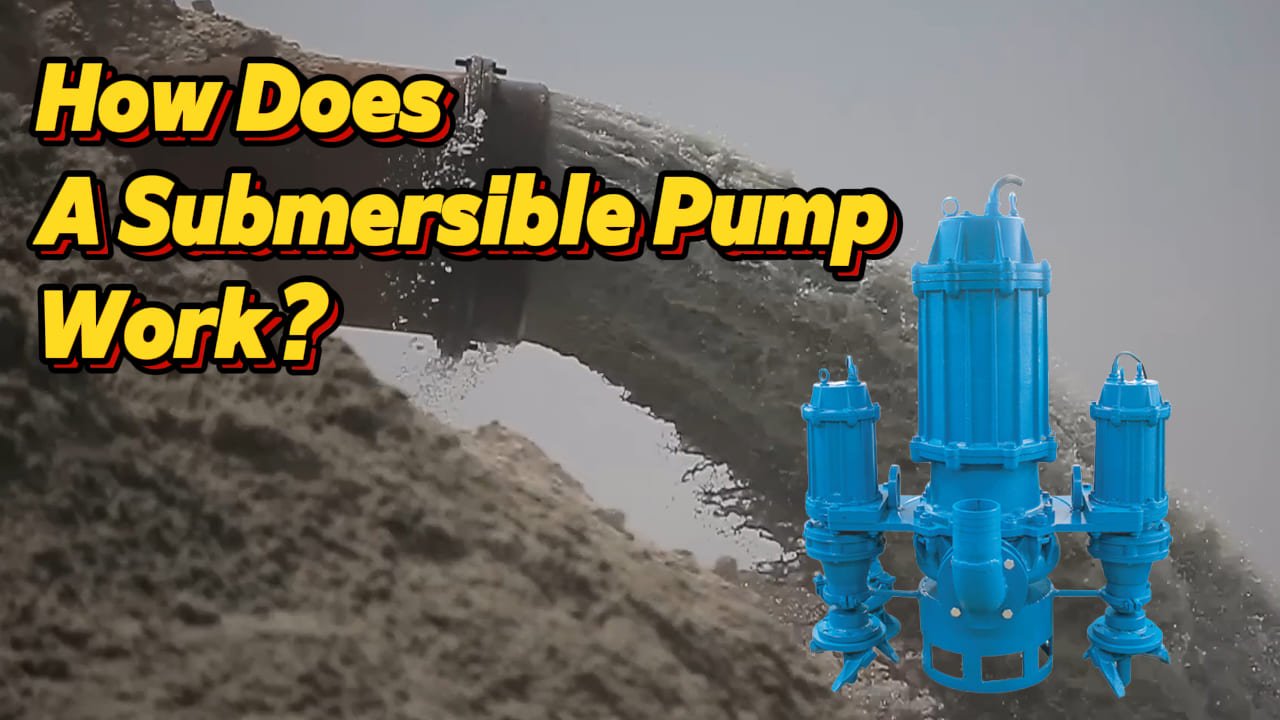
How does a sump pump work?
How does a sump pump work diagram >>>
Sump pumps are typically installed in low-lying areas or sewage pits.
They work by monitoring water level changes through a float switch. Once the water level exceeds the warning line, the motor will start automatically, and then a centrifugal pump located in the sewage will discharge the sewage pit, keeping the water level at a safe position.

Sump pump types and uses
Submersible
The submersible sump pump features a single, integrated motor and pump unit, operating submerged in water for lower noise. It is typically used in sewage wells, sump pits, and reservoirs.
Pedestal
The pedestal sump pump has a vertical design, with the motor above the waterline and the pump submerged. The exposed motor makes maintenance easier. It is generally used in shallow pits or areas with limited underwater space.
What Is a Sewage Pump?
Sewage pumps (sewage ejector pumps) are devices used to treat wastewater containing solid particles, such as underground sewage pipe discharge and septic tank sewage transportation. Sewage pumps can transport solid wastewater that sump pumps cannot handle, making them an ideal choice for wastewater containing particles, kitchen waste, and fibers.
How sewage pump works?
The working principle of a sewage pump is to use a motor to rotate an impeller, generating centrifugal force to pressurize the sewage in the sewage pit and transport it to a higher location or to a sewage pipe or sewage treatment system.
Video explanation: How how does a centrifugal pump work? >>>
Types of sewage pumps
Ejector
A sewage pump (sewage ejector pump) features a clog-free design, an anti-clogging impeller, and a wide flow channel to transport sewage containing larger solids. It is typically used in domestic sewage drainage and sewage treatment plants.
Grinder
A grinder pump is equipped with a cutting device. Before sewage enters the pump, a rotating cutter head pulverizes long, large-diameter solids or fibers, allowing them to smoothly enter the pump for transport. It is typically used in more complex environments with a greater number of long fibers and large-diameter impurities.

Effluent Pump vs Sewage Pump: What’s the Difference?
Effluent pumps are used to transport wastewater containing fine particles, such as greywater, toilet wastewater, and treated wastewater from septic tanks, and are more efficient. Sewage pumps, on the other hand, are used to transport wastewater containing larger solids, such as untreated sewage and domestic wastewater, and have stronger anti-clogging properties.
Vertical Sump Pump vs Submersible Pump
Vertical sump pumps are installed vertically, with the motor above the water level and the pump operating submerged, making maintenance convenient.
Submersible pumps feature a single integrated motor and pump design, operating completely submerged in water, resulting in lower noise and higher efficiency.
Vertical sump pumps are typically used to handle fluids containing solids, such as tailings wastewater and chemical wastewater.
Submersible pumps, on the other hand, are generally used in applications such as sewage wells and irrigation.


How to Choose Between a Sump Pump and a Sewage Pump?
Choosing a sump pump means you need to transport clean water or wastewater containing fine particles, while choosing a sewage pump means you need to transport wastewater containing solids or fibers. The final decision requires consideration of many factors, such as fluid type, particle size, pump head, and flow.
🔶 Based on fluid type
If the fluid to be transported is clean water, a sump pump will suffice. If the fluid to be transported is sewage, wastewater, or other fluids containing impurities, a sewage pump is required.
🔶 Based on particle size
If the fluid contains large solid particles or impurities such as long fibers or toilet paper, then a sewage pump is undoubtedly the best choice because it has excellent anti-clogging and stable performance.
🔶 Based on head & flow requirements
Sump pumps are suitable for low head and low flow rate requirements, while sewage pumps are the ideal choice if you need to pump sewage to higher locations.
🔶 Slurry density
If the fluid you need to transport contains a large amount of high-density solid particles or abrasive particles, such as mine wastewater, tailings, or dredging operations, then neither of these two types of pumps is the best choice. You should choose a more abrasion-resistant slurry pump.
Sump Pump Maintenance and Costs
Typical sump pump maintenance involves checking the float switch and cleaning any residue from the pump to ensure it can start automatically and reduce the risk of blockage.
Sump pump maintenance checklist
- Quarterly Inspection: Operators should conduct routine inspections every quarter, ideally before the rainy season or before use, to ensure smooth operation.
- Sump Cleaning: Regularly cleaning the sump to remove impurities and debris can prevent sump pump blockage.
- Check the Float Switch: Check that the float switch is properly monitoring the water level and automatically opening.
- Check the Check Valve: Ensure the check valve is functioning correctly to prevent sewage backflow.
- Clean the Filter: Clean the filter regularly, removing debris to prevent clogging and reduced flow.
Sump pump maintenance cost
Pump maintenance costs approximately $100-$300 per year, including basic expenses such as cleaning accumulated debris, maintenance materials, and inspections. Regular quarterly and annual maintenance not only maintains high pumping efficiency but also maximizes the pump’s lifespan.
If we perform DIY cleaning monthly or even weekly, aside from the cost of maintenance tools, we generally require no other expenses annually.

Can You Use a Sewage Pump as a Sump Pump?
You can indeed use a sewage pump as a sump pump, as both can transport fluids. This might be acceptable for short-term emergency situations, but long-term use is highly discouraged due to factors like efficiency, energy consumption, and operating costs.
Sewage pumps consume more energy than sump pumps because they are specifically designed for pumping fluids containing solids and require more frequent maintenance. Therefore, we do not recommend this method.
For more complex needs, please feel free to contact our engineers. They will provide free pump selection and professional advice.

FAQ: Sump Pump Questions and Answers
What is a sewage sump pump?
A sewage sump pump, also known as a sewage ejector pump, is a specialized pump designed to handle wastewater containing solid particles, such as toilet wastewater, underground pipe wastewater, and industrial wastewater. The sewage sump pump transports this wastewater containing solid waste through pipelines to a sump or wastewater treatment system.
Do I need both a sump pump and a sewage pump?
Sump pumps and sewage pumps have different functions. If you have a basement or sump that needs to discharge sewage, you need to install a sump pump. If you are located below a main municipal sewage pipe and need to discharge toilet waste, kitchen waste, or factory wastewater, you need to install a sewage pump.
In summary, if you have both of these needs, you must use both types of pumps.
How long does a sump pump last?
The lifespan of a sump pump is approximately 10 years. If you perform regular maintenance and upkeep according to the user manual, its lifespan can even exceed 10 years. However, frequent high-intensity use and high-load operation will significantly shorten the pump’s lifespan.
We recommend that if your pump has exceeded 10 years of lifespan, you should increase the frequency of maintenance to ensure your equipment operates normally..
What happens if sump pump fails?
When a sump pump malfunctions, its pumping function is lost or reduced, leading to severe water accumulation in your basement, causing mold growth, damaging equipment, and even affecting the building structure, creating unnecessary danger.
Common Pump Failures
- Float Switch Failure: A malfunctioning float switch will prevent the pump from starting.
- Overload Operation: Excessive water flow causes the motor to operate under overload for extended periods, eventually damaging the motor.
- Clogging: Impurities and debris in the sewage clog the pump inlet or pipes, hindering drainage.
- Aging: Lack of regular pump maintenance leads to frequent malfunctions.