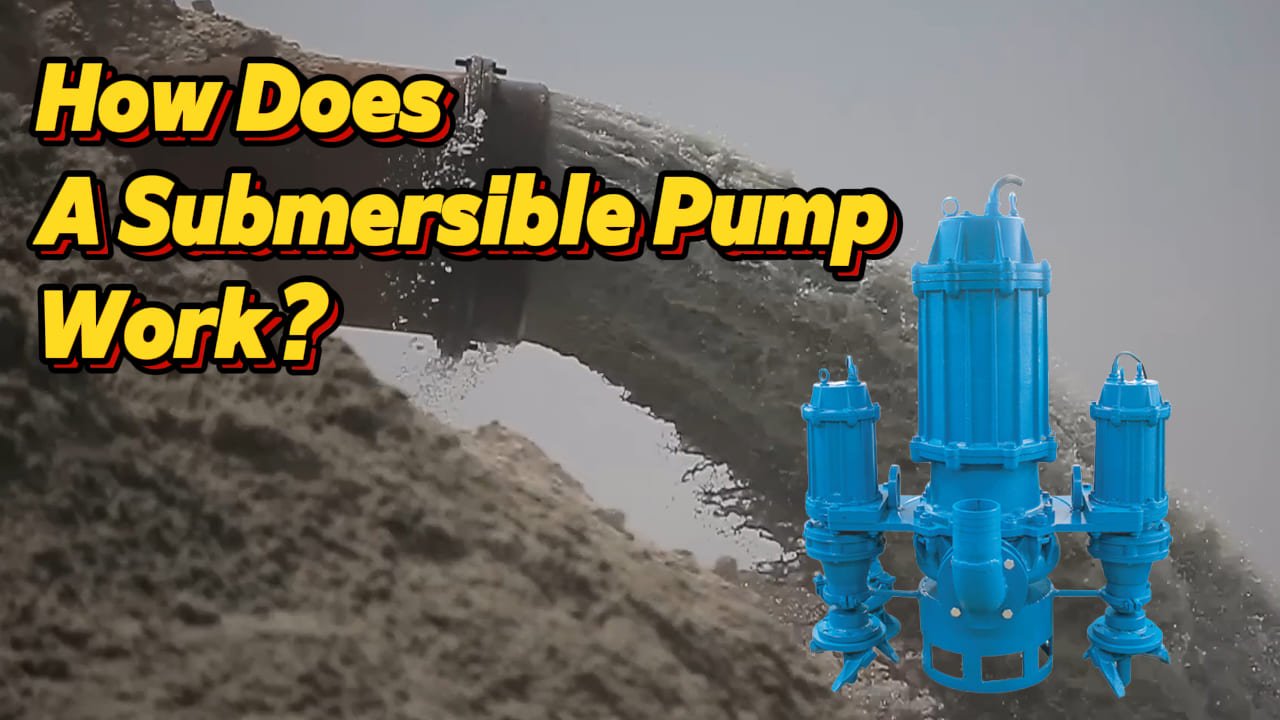
What is a Submersible Pump?
A submersible pump is a pump that operates submerged in water. It uses a sealed motor to drive an impeller to rotate, and the impeller transfers kinetic energy to the liquid. The pump casing or volute converts the liquid’s kinetic energy into pressure.
This pressure forces the liquid to overcome pipe resistance and height differences, transporting the liquid above the water surface.
How Does a Submersible Pump Work? Step by Step
The Motor Drives the Shaft and Impeller
The magnetic field generated by the energized motor causes the rotor to rotate, converting electrical energy into mechanical energy. The pump shaft, as a crucial connecting component, links the motor and the impeller. Ultimately, the motor transfers energy to the impeller, causing it to rotate.


Liquid Enters Through the Intake
The high-speed rotation of the impeller creates a low static pressure zone at the impeller inlet, thus generating a pressure difference between the impeller inlet and the surrounding area. This pressure difference allows liquid to enter the pump.
The Impeller Transfers Energy to the Liquid
The impeller rotation generates centrifugal force. As the impeller continues to rotate, it continuously throws the liquid in all directions and transfers energy to the liquid, thereby increasing the liquid’s flow rate and pressure.


The Diffuser or Volute Helps Build Pressure
The impeller throws the liquid from the center outwards, into the diffuser or volute. The volute collects the liquid and guides it to the pump outlet.
During this process, the gradually expanding flow channel of the volute reduces the fluid velocity and converts some of the liquid’s kinetic energy into static pressure.
Liquid Enters the Discharge Pipe and Overcomes System Head
The liquid is guided into the pump outlet by the volute casing, at which point it has acquired all its mechanical energy, also known as head. The liquid then flows through the pipeline, eventually reaching the target location.
During this process, the liquid needs to overcome the height difference between the pump outlet and the target location, as well as energy losses caused by the pipeline, bends, and valves. As long as the head is sufficient, the liquid will eventually reach the target location.

Main Parts of a Submersible Pump and What They Do
Pump casing
The pump casing is a container that houses the various pump components, and it is generally made of metal.
Motor
The submersible pump’s motor features an integrated sealed design, allowing it to operate underwater and provide energy for liquid flow.
Shaft
The main function of the pump shaft is to connect the motor and the impeller, transmit the energy of the motor, and support the impeller.
Impeller
Impellers are used to transfer energy to liquids and propel them.
Mechanical seals
Mechanical seals are typically installed between the impeller and the motor to seal the gap between the pump shaft and the motor, preventing liquid from entering the motor through the gap and causing equipment damage.
How Does the Motor Stay Sealed and Cool Underwater?
How Seals and Cable Entries Keep Water Out?
There are three potential leakage points during normal operation of a submersible pump:
- The connection between the motor housing and the end cover
- The gap between the pump shaft and the motor housing
- The point where the cable enters the motor housing
Different sealing methods are used to prevent leakage at these three locations:
- The connection between the motor housing and the end cover: O-rings, gaskets, and other rubber components are used to seal the gap at the connection.
- The gap between the pump shaft and the motor housing: A mechanical seal is used to prevent liquid from entering along the shaft without affecting its rotation.
- The point where the cable enters the motor housing: The inlet is typically sealed by compressing a resilient rubber seal at the cable inlet. Other submersible pumps use resin potting to achieve a seal.
How Different Cooling Arrangements Work?
Common motor cooling methods include: ambient liquid cooling and cooling jacket cooling.
- Cooling Jacket Cooling: A cooling jacket is essentially an outer casing installed around the motor. During motor operation, some medium enters the cooling jacket, absorbs the motor’s heat, and then returns to the pump.
- Ambient Liquid Cooling: During motor operation, the heat generated is transferred to the motor housing, and the surrounding flowing liquid continuously cools the motor.
How Do Float Switches and Pump Controls Work?

Automatic Start and Stop with a Float Switch
The main function of a submersible pump float switch is to automatically control the start and stop of the submersible pump, preventing the motor from running dry or water from overflowing.
A tethered float switch uses a sealed buoyant housing containing a tilt switch or microswitch. In common drainage control systems, a high liquid level causes the normally open contact to close, sending a start signal to achieve the function of starting at high liquid levels and stopping at low liquid levels.
What Does a Control Panel Do?
The submersible pump control box acts like a brain, constantly monitoring the pump’s operating status and automatically starting and stopping it as needed.
Typically, a submersible pump control box contains a power controller, relays, float signal interfaces, and other equipment. Users can install additional components according to their needs, such as timer switches and frequency converter control. These optional features can be decided by discussing with the pump manufacturer or engineer.
Do All Submersible Pumps Work the Same Way?
No, not all submersible pumps operate on the same principle. Most common submersible pumps are centrifugal, meaning they transfer energy to the liquid through an impeller. Centrifugal submersible pumps come in various types, categorized by hydraulic type (radial, mixed-flow, axial), and by the number of impellers (single-stage, multi-stage). This article focuses on a common single-stage radial-flow submersible pump.
In a radial-flow pump, the liquid flows radially outwards. In an axial-flow pump, the impeller is more like a propeller, with the liquid moving axially through the impeller. In a mixed-flow pump, the liquid moves both axially and radially.
The working processes of single-stage and multi-stage pumps also differ. A single-stage pump contains only one impeller; the liquid, after work done by the impeller and guided by the volute, flows out through the outlet. In a multi-stage pump, after passing through the first impeller, the liquid enters the second impeller. Each impeller transfers energy to the liquid, ultimately allowing the multi-stage pump to achieve a higher head.
What Determines a Submersible Pump’s Flow and Pressure?
How Flow Rate and Head Relate
Flow rate and head are the main parameters representing pump performance. Each pump has its own flow rate-head curve based on its impeller and pump body structure. In common centrifugal pump curves, the head is higher when the flow rate is lower, and the head gradually decreases as the flow rate increases.
However, determining the actual operating point of the pump is also based on a gradually upward-sloping system curve. The intersection of the system curve and the flow rate-head curve is the actual operating point.
Why Water Level and Pipe Resistance Matter
Working liquid level, elevation difference, and pipeline losses are crucial for calculating total head and pump selection. Total head includes factors such as liquid level difference and pipeline losses.
The lower the actual pumping level, the greater the static head and the smaller the flow rate. Furthermore, the liquid must overcome resistance from elevation differences, pipeline friction, and bends as it moves through the pipeline. Therefore, installation depth cannot be used as a direct indicator of total head.
How Solids and Wear Affect Performance
There are significant performance differences between pumps conveying slurry containing suspended solids and clean water. Slurry containing suspended solids increases impeller and pipeline friction, leading to increased conveying resistance. Prolonged conveying of slurry containing suspended solids can also erode the impeller and other wet-end parts, resulting in deteriorated pump hydraulic performance. Solids can also cause blockages in pipelines and the impeller.
In short, slurry containing suspended solids and abrasion have a significant impact on pump performance, ultimately leading to decreased flow rate and head, vibration and noise, and potential changes in motor power.
Video-How a Slurry Pump Work? (Centrifugal Pumps)
FAQ About Submersible Pump
Does a submersible pump need priming?
No, submersible pumps don’t need priming because they operate entirely underwater, and the liquid will naturally fill the pump before startup.
Different Types of Submersible Pumps
- Submersible Water Pump
- Submersible Slurry Pump
- Submersible Pump with Oil Filling
- Submersible Stainless Steel Pump
- Booster Pump
- Grinder Pump
- Submersible Well Pump
- Dry Pit Pump
- Submersible Sewage Pump
- Dewatering Pump
Why is my submersible pump running but not pumping water?
If a submersible pump is running but not pumping water, it’s usually due to air lock, inlet blockage, or valve blockage.
First, disconnect the power supply and resolve the air lock issue. Adjust the pump’s angle underwater to expel air. Inspect the inlet and filter, and remove any debris clogging the inlet. Check all valves to ensure they are fully open.
Can a submersible pump run continuously?
Yes, submersible pumps can run continuously, but it is important to ensure that there are no malfunctions and that they are always submerged in liquid.