Different application scenarios and different pumping media are all factors we need to consider when selecting a pump. The most common types on the market are vertical centrifugal pumps and horizontal centrifugal pumps, but what are the differences between them?
This article, as a practical guide, aims to provide you with comprehensive guidance. You can find the following information in this guide:
- Vertical Pump vs Horizontal Pump Comparison Table
- How to Choose
- NPSH, Installation and Performance Comparison
- Maintenance & Cost
- Expert Tips…
What’s the difference?
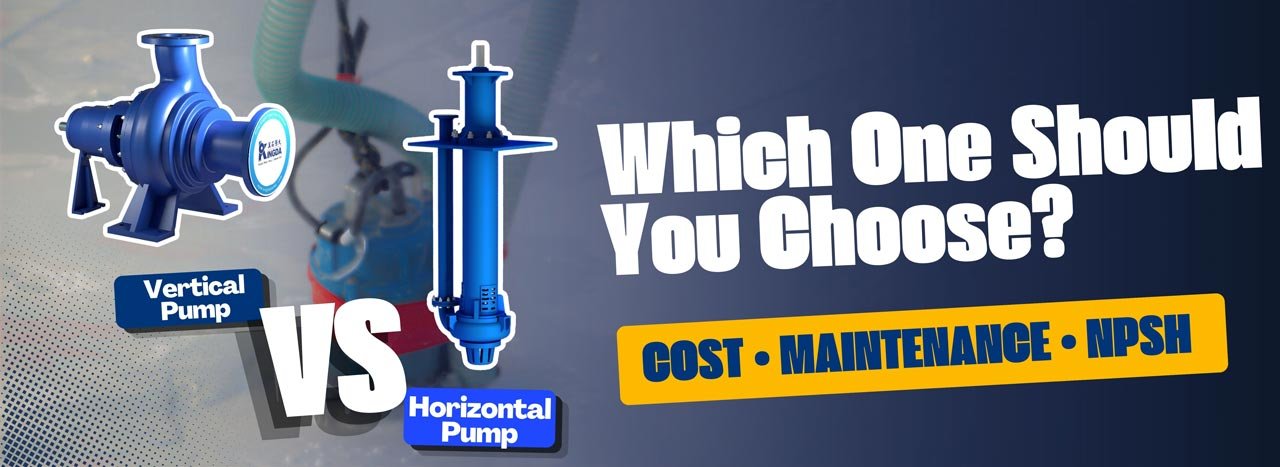
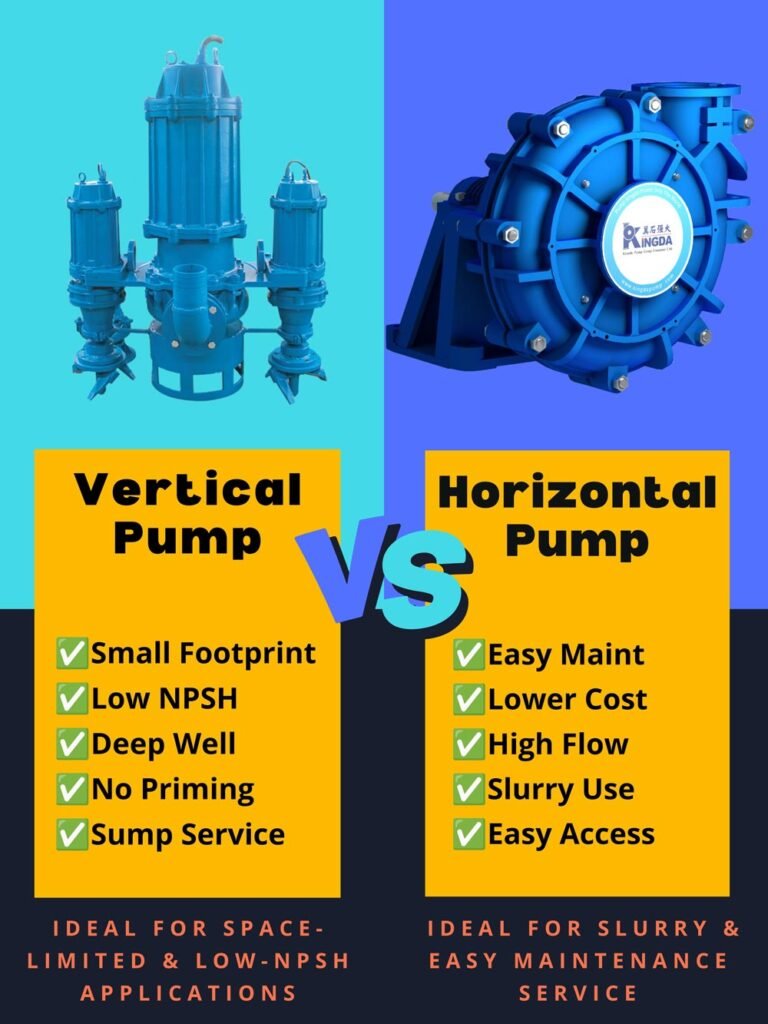
The main differences between vertical and horizontal pumps lie in their installation methods, ease of maintenance, and performance.
Regarding installation, horizontal pumps are installed parallel to the ground, requiring a larger footprint, while vertical pumps are installed perpendicular to the ground and can be submerged in a water pit, offering a significant advantage in confined spaces.
Obviously, horizontal pumps placed parallel to the ground are easier to maintain, while vertical pumps require crane lifting for maintenance.
In terms of performance, horizontal pumps are more stable than vertical pumps and can deliver larger flow rates, making them suitable for applications requiring stable, high-flow-rate pumping.
Vertical Pump vs Horizontal Pump: Side-by-Side Comparison
| Key Differences | Horizontal Pump | Vertical Pump |
| Footprint | It requires a larger footprint and necessitates the installation of a metal or concrete base. | Its vertical structure occupies less space and can be submerged in narrow water pits. |
| NPSH | It is necessary to ensure that NPSHa > NPSHr, otherwise cavitation is likely to occur. | The pump inlet is submerged in the liquid, which effectively prevents cavitation. |
| Priming | The pump needs to be filled with water before it can be operated. | No pre-filling with water is required; the pump inlet is typically submerged in water. |
| Maintenance | Maintenance is convenient; workers can directly disassemble pump components. | Maintenance is quite complicated, requiring a crane to lift the pump out of the sump. |
| Installation | Installation is simple and convenient. | The installation is complex and requires a crane to be placed inside the sump. |
| Motor Options | A diesel engine or an electric motor can be selected. | Only the motor is provided; the motor and pump are designed as a single unit. |
| Typical Applications | Suitable for applications with a large and stable traffic range. | Suitable for pumping groundwater (deep wells, sump pits, ponds). |
When Should You Choose a Horizontal Pump?
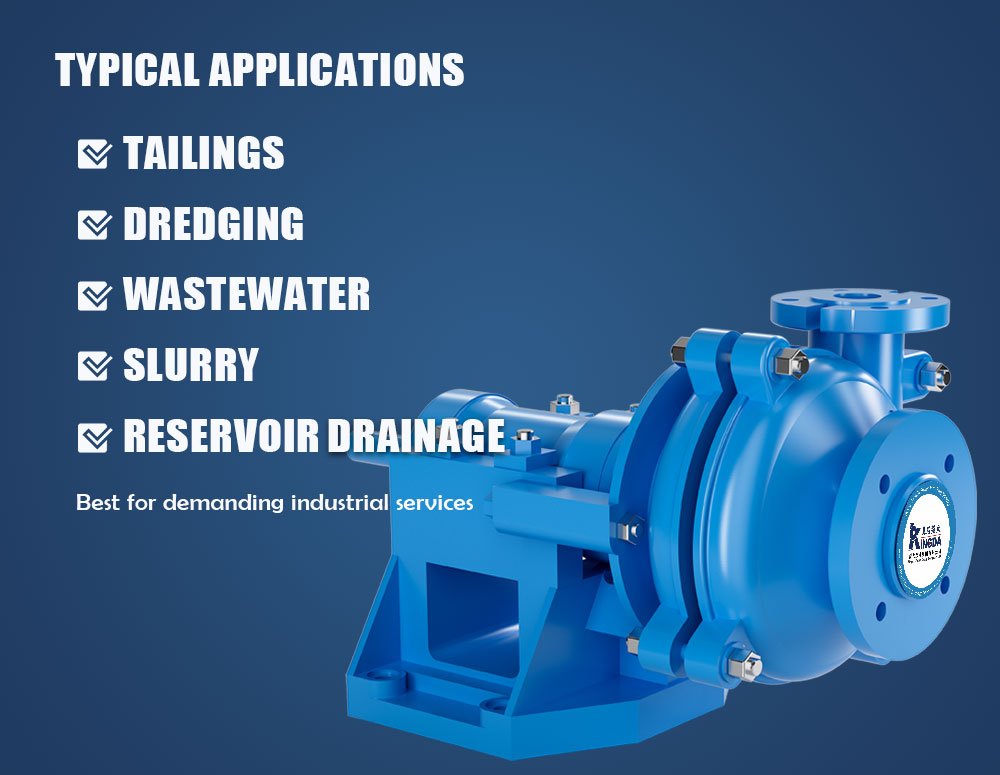
Horizontal centrifugal pumps offer advantages such as high stability, convenient maintenance, and suitability for high-flow-rate applications. These unique advantages enable them to handle demanding pumping challenges, including complex applications like reservoir drainage, wastewater treatment, tailings processing, and dredging.
If you require easy maintenance, high-flow-rate drainage, processing of slurries containing solid particles, or have limited installation space, then choose a horizontal pump for higher production efficiency.
When Should You Choose a Vertical Pump?
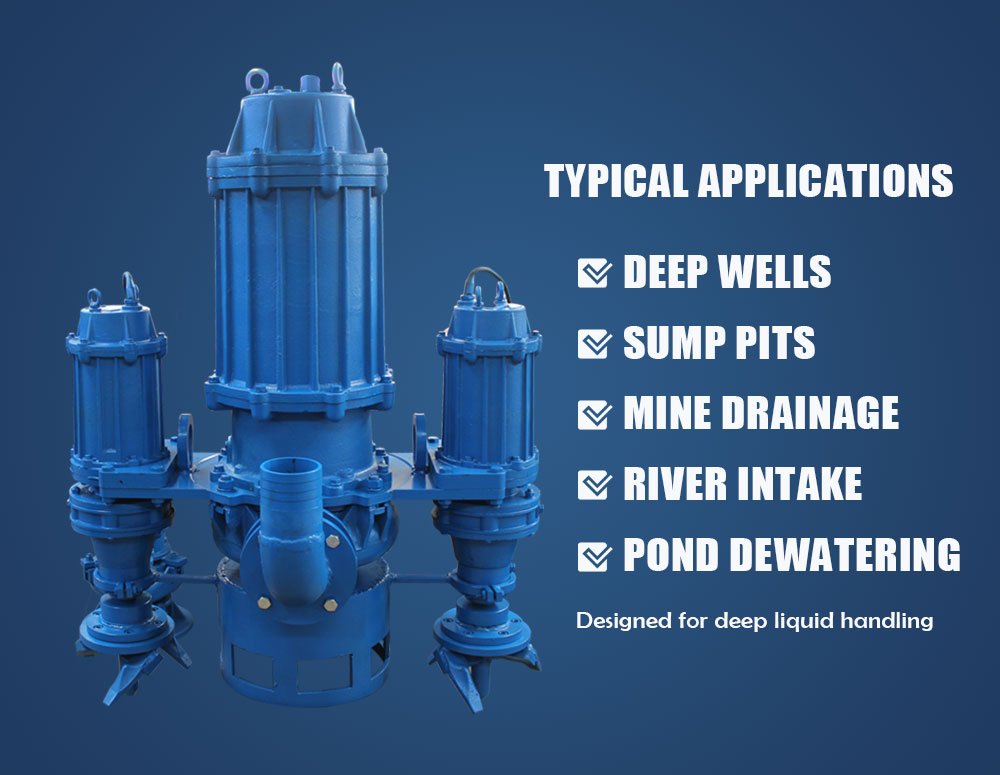
Vertical centrifugal pumps save more space and can operate submerged in liquids. They have lower NPSH (NPSH level) and are less prone to cavitation, making them suitable for most deep well applications, such as deep water intake, deep sump discharge, river and pond drainage, riverbed dredging, and even mine wastewater drainage.
If your installation space is limited and you need the pump to operate submerged in liquid, then choose a vertical pump. Vertical pumps not only fit in confined spaces but also more easily meet NPSH requirements, resulting in fewer maintenance needs.
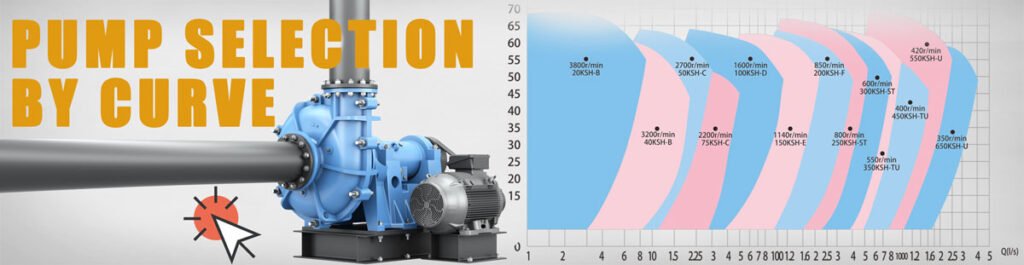
Understanding Horizontal and Vertical Pump Designs
What Is a Horizontal Pump?
A horizontal pump is a pump device placed horizontally with its shaft parallel to the ground. The drive motor, coupling, and pump are all in a straight line. The horizontal design is the most common design among industrial pump equipment. It is commonly used in municipal water supply, industrial wastewater treatment, agricultural irrigation pumping stations, slurry treatment, and other industrial water treatment applications.
Typical designs of horizontal pumps include end suction pumps, split-case pumps, and multistage pumps.
What Is a Vertical Pump?
A vertical pump is a pump that is placed vertically with its shaft mounted vertically. Equipped with a waterproof motor, the pump and motor are integrated into a single design, resulting in a small footprint and allowing for complete submersion in liquids. They are commonly used in applications requiring operation in confined spaces and underwater, such as deep well water extraction, sump drainage, lake dredging, and tailings pond transport.
Typical designs of vertical pumps include vertical turbine pumps, vertical inline pumps, and sump pumps.
NPSH Comparison: Why Vertical Pumps Often Perform Better in Low-NPSH Applications
Vertical pumps are fully submerged in water during operation, with the pump inlet located below the liquid surface or even deeper. This gives them a natural static pressure, resulting in a larger usable net positive suction head (NPSHa) compared to horizontal pumps. Consequently, they are less prone to cavitation. This is the NPSH difference between horizontal and vertical centrifugal pumps.
Here, I need to add that the primary cause of cavitation is NPSHa > NPSHr. Therefore, under the same conditions, vertical pumps are better suited for low-NPSH applications than horizontal pumps.
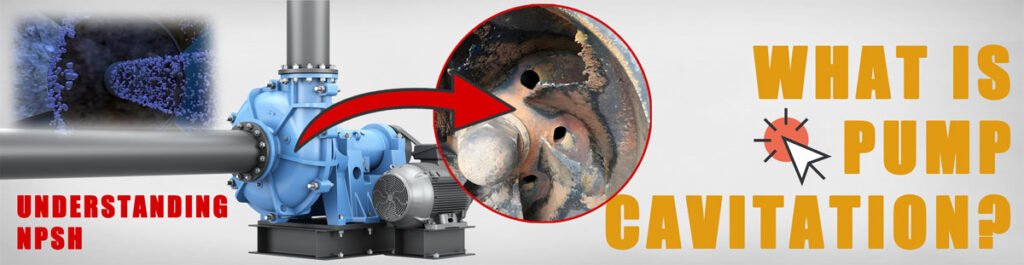
What Is NPSH and Why Does It Matter? →
Priming Requirements: Vertical vs Horizontal Centrifugal Pump
Horizontal centrifugal pumps require priming before operation, while vertical centrifugal pumps do not. Most vertical centrifugal pumps operate fully submerged in water, and this self-priming characteristic is a major advantage of vertical pumps. Horizontal pumps, on the other hand, are installed parallel to the ground and require priming before operation to purge air from the pump and prevent it from running dry.
Maintenance and Bearing Life Comparison
Maintenance horizontal vs vertical centrifugal pumps
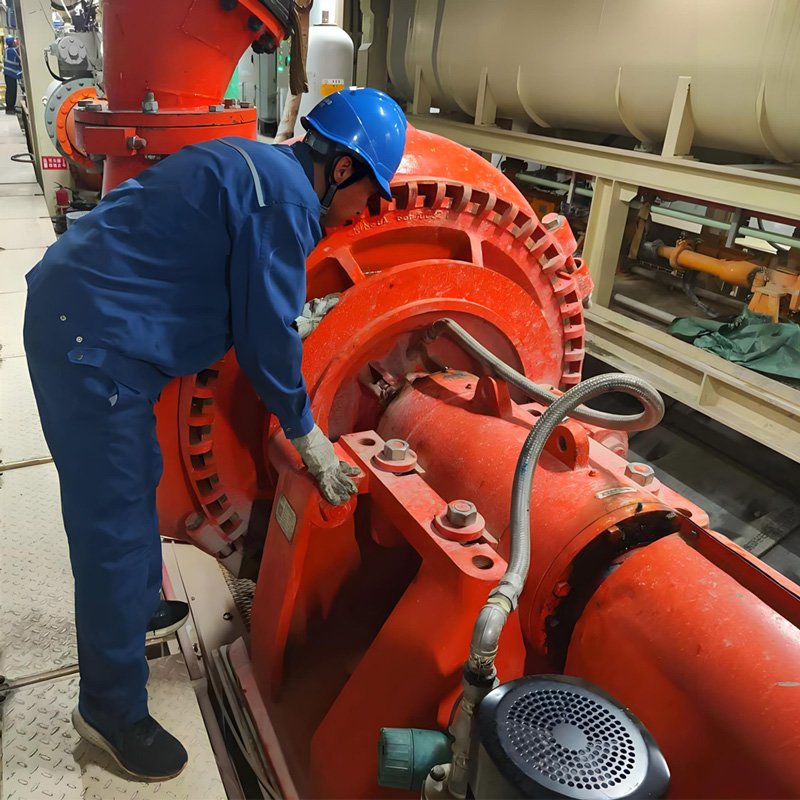
Compared to vertical pumps, horizontal pumps are placed on the ground, with the motor and pump body separate, making maintenance much easier. Technicians can directly disassemble the pump casing or pump components to inspect for wear without using manual lifting or hoisting equipment.
Vertical pumps, on the other hand, operate underwater and have an integrated motor and pump design. Therefore, maintenance requires using a hoist to lift the pump out of the deep water pit or liquid before any maintenance can be performed.
Bearing life horizontal vs vertical centrifugal pumps
Bearings play a crucial role in pumps, ensuring smooth operation and preventing abnormal frictional wear between components. Bearing life largely depends on the axial and radial loads on the bearing.
In horizontal pumps, the horizontally positioned pump shaft distributes most of the weight, resulting in the bearings bearing only a small radial load. In contrast, vertical pumps are typically vertically suspended, and due to gravity and hydraulic forces, the bearings bear a greater axial thrust.
Therefore, during long-term operation, the bearings in horizontal pumps have a longer service life and require more frequent maintenance.

Pump Failure Causes and Maintenance Guide →
Installation and Lifecycle Cost Comparison
Installation Cost Horizontal Vs Vertical Centrifugal Pumps
Horizontal pumps have lower initial installation costs, requiring only a metal or concrete base. Vertical pumps have higher installation costs, requiring the construction of a concrete pit or container to house the pump. However, horizontal pumps occupy a larger area, making them unsuitable for space-constrained environments, while vertical pumps save more space.
Maintenance Cost
Horizontal pumps are simple and inexpensive to maintain; workers can disassemble the pump casing, replace parts, or maintain the motor simply by operating from the ground. Vertical pumps, on the other hand, are much more expensive to maintain, requiring manual labor or lifting equipment to hoist the pump from the deep well or sump for servicing.
Flow Rate, Head Range Comparison
Flow Rates Horizontal Vs Vertical Centrifugal Pumps
The stable structure of horizontal pumps allows them to withstand significant water flow impacts, enabling a wide flow range, typically from several thousand to ten thousand cubic meters per hour.
Vertical pumps, with their compact design, are built for confined spaces and are suitable for low to medium flow applications, typically ranging from several hundred to several thousand cubic meters per hour.
Head Range Vertical Vs Horizontal Centrifugal Pump
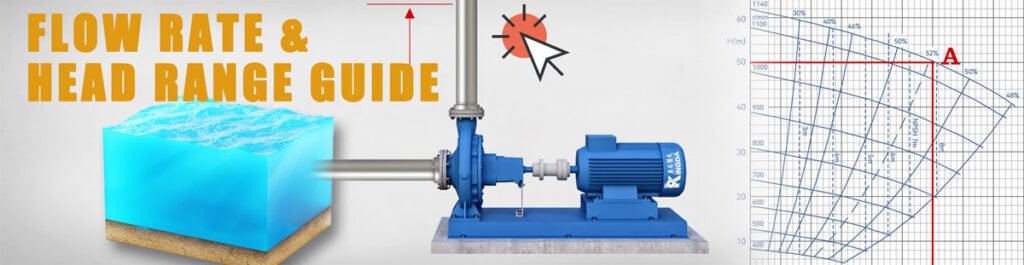
Horizontal pumps have a higher head than vertical pumps, reaching up to several hundred meters, while vertical pumps have a smaller head range, typically in the tens of meters.
Typical Applications: When to Choose Each Pump Type
| Application | Recommended Pump Type |
| Mining | Horizontal |
| Dredging | Horizontal |
| Wastewater Lift Station | Vertical |
| Deep Well | Vertical |
| Fire Protection | Split Case |
| HVAC | Vertical Inline |
| Municipal Water Supply | Both |
Vertical vs Horizontal Split Case Pump
Orientation
The main difference between a vertical split-case pump and a horizontal split-case pump lies in their installation methods. A vertical split-case pump is installed vertically, with the motor at the top and the pump casing divided into two parts along the vertical plane, resulting in a smaller footprint.
A horizontal split-case pump, on the other hand, is installed horizontally, with the motor and pump on the same straight line, and the pump casing divided into two parts along the horizontal plane, resulting in a larger footprint.
Maintenance
Horizontal split case pumps are easier to maintain. Maintenance personnel only need to disassemble the upper part of the pump casing to maintain components such as impellers and bearings.
Vertical split case pumps are more complex to maintain. A crane is required to separate the motor located above the pump before the pump casing can be disassembled to maintain the impeller or other pump components.
Expert Recommendation From Kingda Engineers
Since 1948, Kingda, as one of China’s first slurry pump manufacturers, has extensive experience in manufacturing and fluid transport solution design. Our project portfolio includes complex fluid transport systems such as municipal engineering, industrial wastewater treatment, TBM slurry transport, mineral slurry transport, dredging, and FGD systems.
If you have any questions about pump selection, maintenance, or fluid transport solution design, please contact Kingda Expert. Our professional engineers will provide you with free, fast, and professional advice.
Conclusion
When faced with the difficult decision of choosing a pump, this guide provides a detailed understanding of the advantages of vertical and horizontal pumps. We will find that, regardless of the type of pump chosen, it is essential to select one based on your pumping needs and costs. Only the pump best suited to the project’s operating conditions will achieve maximum efficiency.
FAQ
Are vertical pumps more efficient than horizontal pumps?
It’s not that vertical pumps are more efficient than horizontal pumps. Efficiency depends on the specific application conditions, such as the density, viscosity, and abrasiveness of the medium. Only pumps suitable for the appropriate conditions can achieve higher efficiency.
For example, horizontal pumps are suitable for high-flow-rate applications, while vertical pumps are better suited for pumping liquids in confined spaces.
Which pump is easier to maintain?
Horizontal pumps are easier to maintain. Placed on the ground with the motor and pump aligned in a straight line, technicians can quickly disassemble the pump casing to maintain the impeller or other pump components.
Vertical pumps, being submerged in water, require being lifted out before maintenance. Furthermore, the motor and pump are integrated, making maintenance procedures more cumbersome.
Do vertical pumps require priming?
Vertical pumps typically operate submerged in water, deep wells, or sump pits. Before operation, liquid has already accumulated inside the pump, and excess air has been expelled. This unique advantage allows vertical pumps to operate without priming.
Which pump is better for slurry applications?
Horizontal slurry pumps are better suited for slurry applications because their robust and stable structure can withstand the impact of large water flows and is suitable for long-term operation.
However, both horizontal and vertical pumps have models suitable for slurry applications. By using wear- and corrosion-resistant materials, frictional wear from solid particles in the slurry can be effectively avoided.
Which pump handles low NPSH better?
Vertical pumps are better suited for low NPSH conditions. As they operate submerged in water, vertical pumps have a natural static pressure, which gives them a larger usable net positive suction head (NPSHa). Even in low NPSH environments, vertical pumps can effectively prevent cavitation.
Can a horizontal pump be installed vertically?
Horizontal pumps are not installed vertically because their structure is designed to be placed horizontally. Typically, the drive motor, coupling, and pump are on the same horizontal line. This structure is for horizontal installation. You can replace the pump with a suitable vertical pump according to your pumping needs.
What is a vertical split case pump?
A vertical split case pump is a vertically installed split case pump with the motor located above the pump, and the pump casing divided into two parts along the vertical plane. It is compact, occupies little space, and is suitable for installation in confined areas.
Which pump lasts longer?
The lifespan of a pump depends on many factors, such as the manufacturing materials and the pumping medium. Under the same conditions, horizontal pumps have a longer lifespan than vertical pumps because horizontal pumps have a more stable structure and are easier to maintain, while vertical pumps are more complex and require more manpower and resources to maintain.