What Is a Volute Pump?
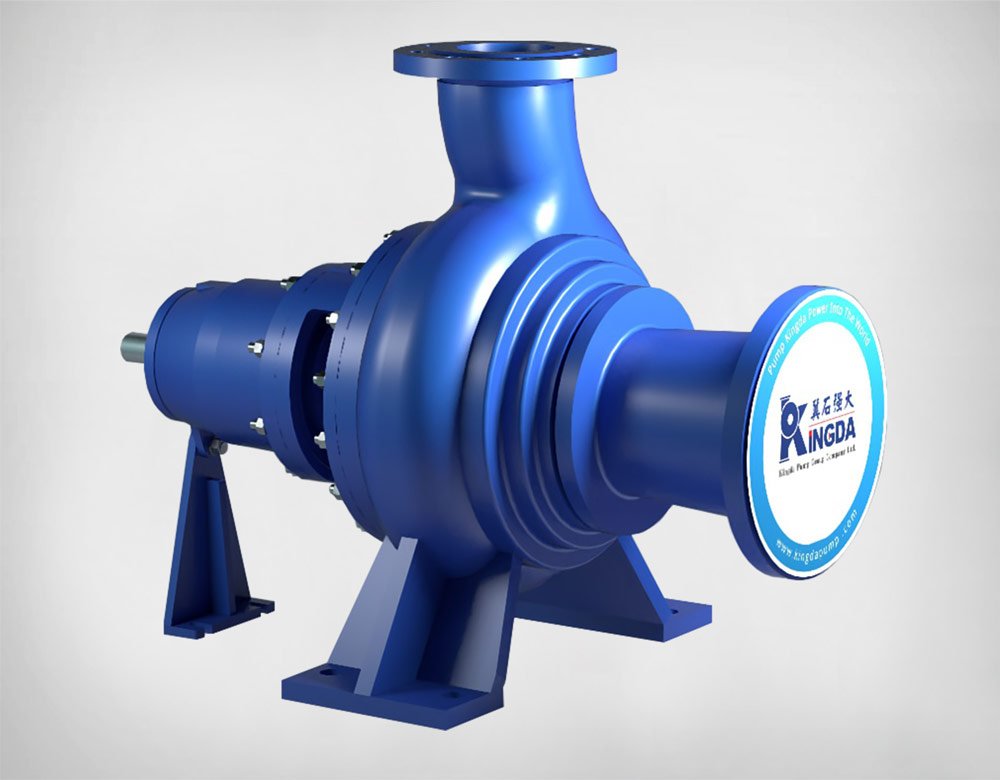
A volute pump is a type of centrifugal pump. It has a spiral volute around the impeller to collect the liquid flowing from the impeller outlet. This volute causes the liquid to move rapidly along the casing and is then pumped out through a pipe at the pump outlet.
Volute centrifugal pumps are characterized by high efficiency and stability, and are commonly used in municipal water treatment, industrial wastewater treatment, agricultural irrigation, and mine slurry treatment.
How Does a Volute Pump Work?
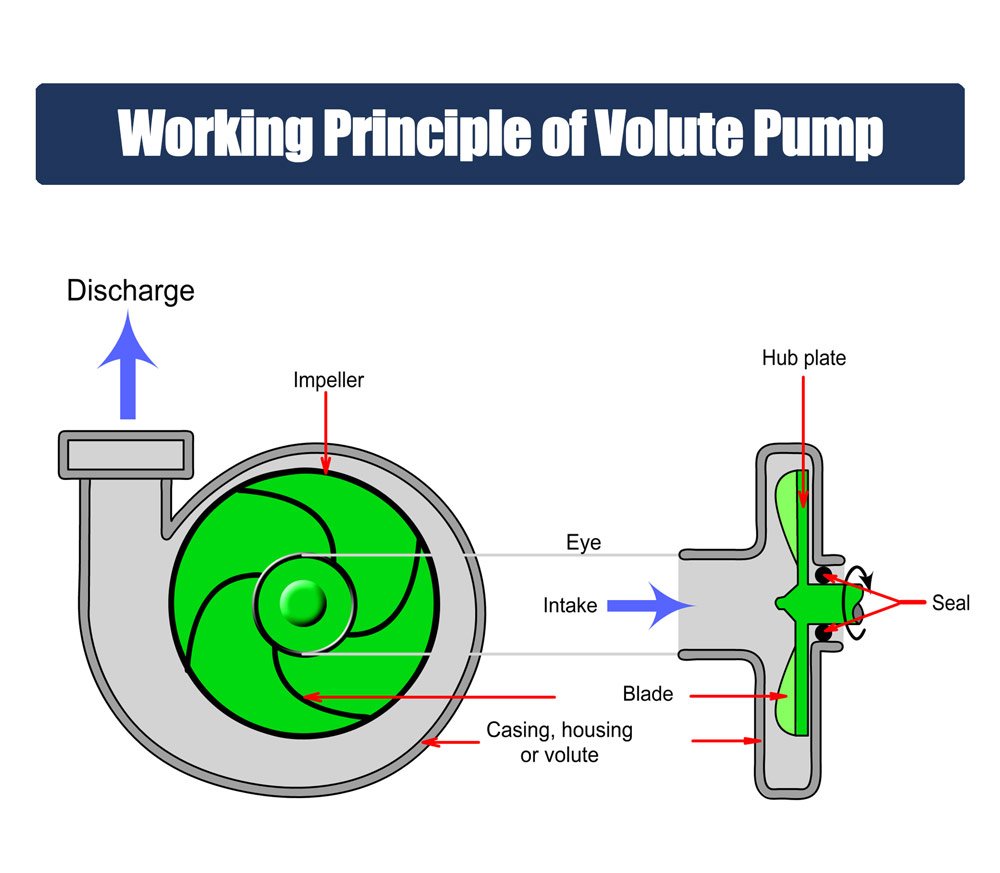
When the volute pump is working, the impeller rotates at high speed, creating a negative pressure at the suction inlet, drawing in liquid, which is then thrown out at the impeller outlet.
At this point, the high-speed moving liquid enters the pump volute, and the spiral shape of the pump volute reduces the liquid’s velocity, converting some of its kinetic energy into pressure energy. Finally, the high-pressure liquid flows out from the pump outlet.
See how a volute centrifugal pump works? >>>
What is a volute on a pump?
The volute is a crucial working component in a centrifugal pump. Located around the impeller, it primarily guides water from the impeller outlet into the volute’s spiral flow channel, converting some of the liquid’s kinetic energy into pressure energy, reducing hydraulic losses, and pumping the liquid out at high pressure.
Volutes are typically cast from materials such as ductile iron, stainless steel, or high-chromium alloys, exhibiting characteristics such as robustness, wear resistance, and corrosion resistance, enabling them to withstand the impact of large flow rates.
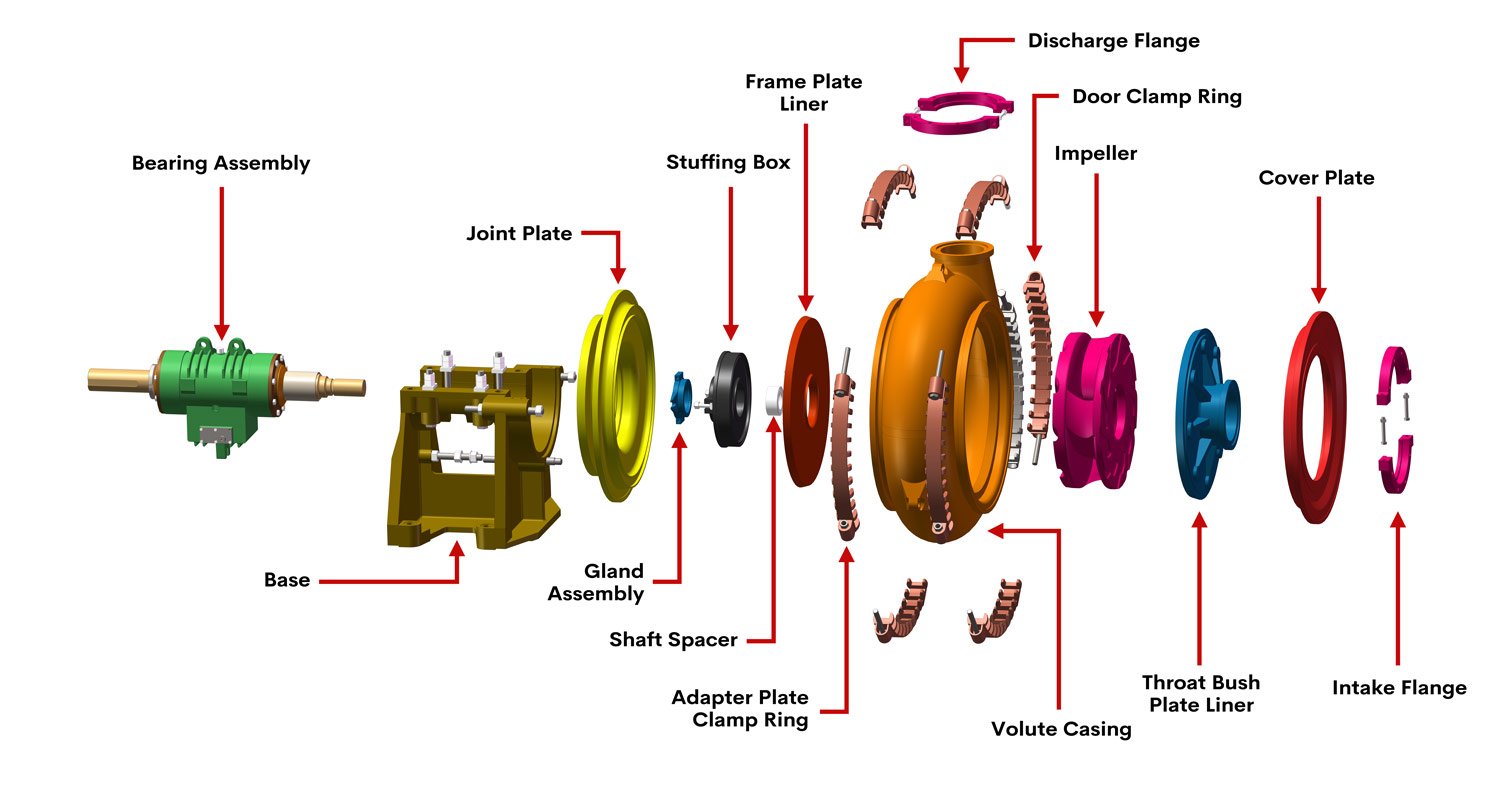
Main Components of a Volute Pump
Impeller
The impeller is an important rotating component in volute pump parts. The impeller draws liquid into the center of the impeller by rotating, and then throws it out at high speed to the surrounding area of the impeller.
Volute Casing
A pump volute casing is a container that surrounds the impeller and has a spiral flow channel inside for the liquid to move within the channel, reducing hydraulic losses.
Shaft
The pump shaft is used to connect the impeller and the drive unit. The kinetic energy of the drive unit is transferred to the impeller through the pump shaft, which also provides support for the pump.
Mechanical Seal
A mechanical seal isolates liquid from the atmosphere, preventing leakage and damage to equipment. It consists of two extremely smooth sealing surfaces: a dynamic ring and a stationary ring.
Bearings
The bearing supports the pump shaft and contains a ring of steel balls. When the pump starts, these balls begin to roll, reducing friction in the shaft. The bearing also helps to withstand radial and axial forces on the shaft, extending its service life.
Volute Pump Casing Design
Spiral Geometry
As the liquid is continuously thrown towards the volute by the impeller, the liquid velocity will increase. In order to prevent turbulence and energy loss, the volute pump casing is designed with a spiral structure to reduce hydraulic loss and continuously collect the liquid flowing out of the impeller.
Area Expansion
Liquid is continuously thrown out at high speed from the outer periphery of the impeller, which leads to an increasing total flow rate and a gradual increase in velocity. To reduce the impact of excessive velocity on the pump, causing vibration and noise, the spiral volute has a gradually increasing cross-sectional area, which makes the liquid velocity approach stability and prevents efficiency loss.
Pressure Recovery
The impeller primarily provides velocity to the liquid during the entire operation process. The liquid exiting the impeller has a high velocity but low pressure. As the cross-sectional area of the impeller gradually increases, the liquid velocity gradually decreases. At this point, some of the liquid’s kinetic energy is converted into pressure energy, and the liquid pressure increases.
Volute Pump Casing Material
The material of the volute pump casing directly determines its lifespan. Volute pumps are in constant contact with abrasive, corrosive, high-speed, and high-pressure liquids. Inappropriate or inferior materials will directly reduce their lifespan. Matching the material to the medium being pumped can maximize the service life. Common materials include cast iron, stainless steel, rubber, and high-chromium alloys.
Types of Volute Pumps
| Type | Key Features | Recommended Use | Typical Industries |
| Single Volute Pump | Easy to maintain and low cost | Suitable for low to medium flow and pressure scenarios | 🔸Industrial water supply 🔸HVAC 🔸Irrigation |
| Double Volute Pump | Reduced radial load, robust structure | Suitable for high-voltage, high-flow scenarios, especially in harsh environments | 🔸Mine wastewater 🔸Mine slurry 🔸TBM slurry 🔸Power plant circulating water |
| Vertical Volute Pump | Save space | Suitable for scenarios with limited space or vertical installation | 🔸Power plants 🔸Fire protection 🔸Municipal water supply |
| End Suction Volute Pump | Easy to maintain and simple to install | Suitable for general water supply and circulating water systems | 🔸Wastewater treatment 🔸Irrigation 🔸Mining wastewater |
| Double Suction Volute Pump | High flow rate, hydraulic balance, and greater stability | Suitable for scenarios with high traffic demand | 🔸Large-scale water supply systems 🔸Municipal water supply |
| Axially Split Volute Casing Pump | The separate pump casing makes maintenance easy | Especially suitable for high-volume emission scenarios | 🔸Large pumping stations 🔸Fire water supply 🔸Water treatment |
Volute Pump vs Diffuser Pump
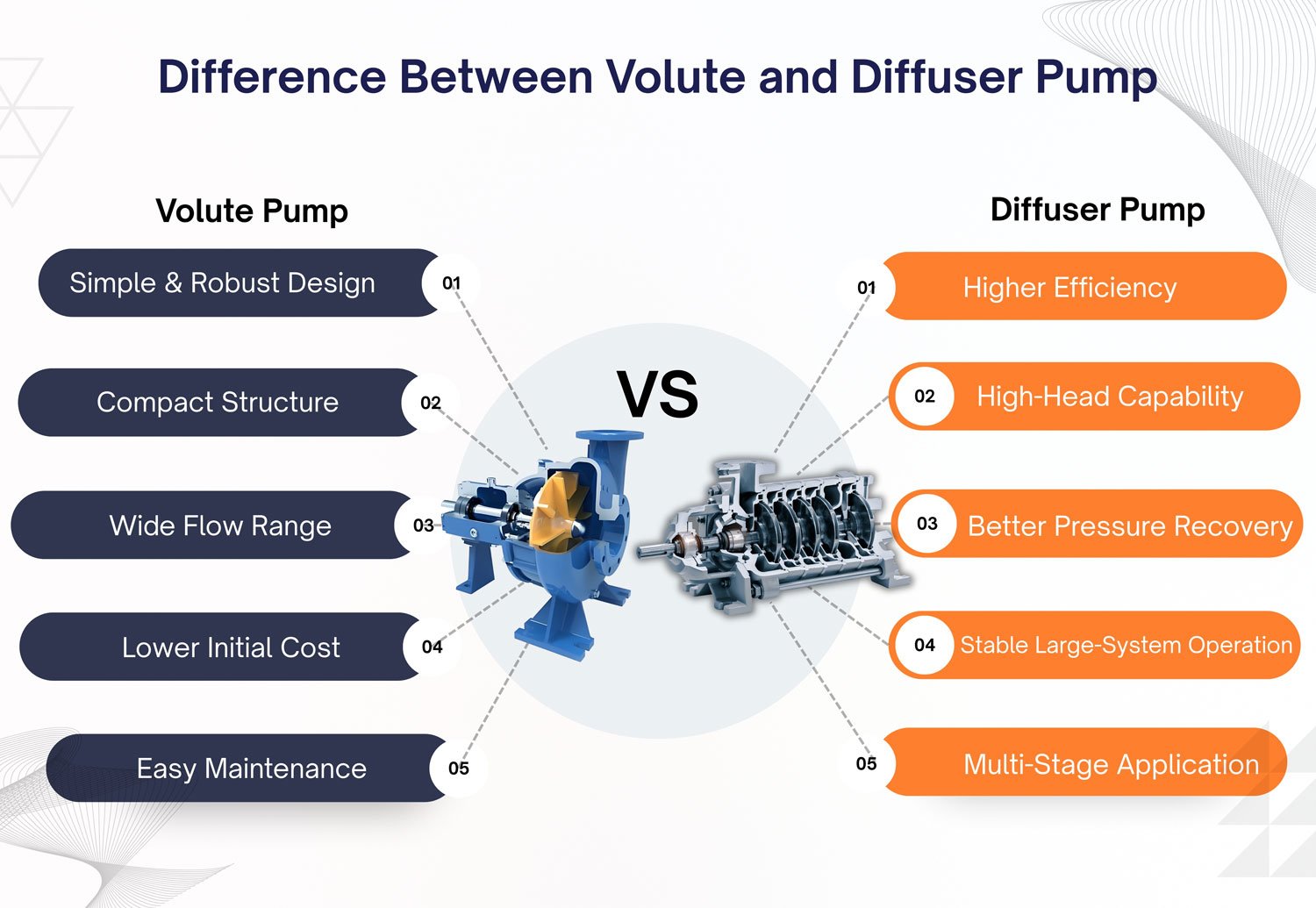
Difference Between Volute and Diffuser Pump
Both volute pumps and diffuser pumps are centrifugal pumps that convert kinetic energy into pressure energy to pump liquids. However, unlike volute pumps which use a spiral volute to increase pressure, diffuser pumps achieve this energy conversion through multiple diffuser stages (diffuser vanes).
A diffuser pump contains a series of diffuser vanes. As the liquid passes through each vane, its velocity gradually decreases, and its pressure gradually increases. This allows the diffuser pump to deliver higher pressures and achieve higher delivery efficiency. However, due to the large number of diffuser vanes, it is heavier and larger in size.
| Feature | Volute Pump | Diffuser Pump |
| Pressure Recovery | Spiral volute casing | Diffuser vanes |
| Hydraulic Efficiency | High | Generally higher near the design point |
| Operating Range | Wider | Narrower |
| Manufacturing Complexity | Simple | More complex |
| Cost | Lower | Higher |
| Maintenance | Easier | More difficult |
| Solids Handling | Better | Less suitable for abrasive or solids-laden fluids |
| Typical Applications | Water supply, slurry, wastewater | Boiler feed, multistage pumps, high-pressure services |
Which One Should You Choose?
For general industrial water treatment, choose a volute pump. Volute pumps are simple in structure, easy to maintain, wear-resistant, and lower in cost, making them suitable for general water supply, irrigation systems, HVAC, fire protection, circulating water systems, and even mine wastewater and slag treatment.
If you require high-pressure water or prioritize high-efficiency delivery, choose a diffuser pump. Diffuser pumps have multi-stage pressurization capabilities, providing higher pressures and are widely used in chemical, oil, and natural gas industries where high-pressure pumping environments are required.
Common Applications of Volute Pump
Water Supply
In water supply applications, volute pumps are mainly used to transport clean water, drinking water, and industrial water. The high efficiency design of volute pumps makes them an ideal choice for water supply.
Mining & Mineral Processing
In mining and mineral processing, there are large amounts of slurry, tailings, and wastewater containing solid particles, which requires volute pumps to have exceptional abrasion resistance. Slurry pumps excel at performing these tasks.
Dredging
During dredging operations, the liquid contains a large amount of mud, silt, fibers, and garbage. This requires the volute pump to withstand the long-term scouring of sand and gravel, and also to have excellent anti-clogging performance. The dredge pump is the ideal choice for dredging.
Power Plant
In the cooling water circulation and process water systems of power plants, reliable and stable pumping equipment is required to ensure the stable operation of the entire process. Volute pumps, with their stable and reliable technology, have become the best choice for this application.
Wastewater
Wastewater contains a large amount of impurities, fibers, and debris. The wide flow channel of the volute pump can smoothly pump out these solid impurities, and its good wear resistance can also better resist the high-speed scouring of solids on the volute casing.
Volute Pump Materials
High Chrome
High chrome material has excellent abrasion and corrosion resistance, can withstand the scouring of hard particles in slurry for a long time, and can also adapt to moderately corrosive slurries. It is especially suitable for volute pumps that need to transport abrasive and corrosive slurries.
Rubber
When the slurry contains a large number of fine particles or contains chemical media such as acids and salts, we recommend choosing rubber material.
Rubber slurry lined pumps have excellent elastic properties, effectively preventing friction from fine particles, and rubber does not easily react with acids and salts, providing excellent corrosion resistance.
Cast Iron
Cast iron is the most common material, with low cost, good casting performance, and high rigidity. It is suitable for most clean water and mildly corrosive conditions and are widely used. However, cast iron has poor abrasion resistance and is not suitable for abrasive conditions.
Duplex Stainless Steel
Duplex stainless steel has excellent impact toughness and corrosion resistance, and duplex stainless steel volute pumps can be widely used in industries such as textiles, pulp, pharmaceuticals, chemicals, sugar refining, and metallurgy.
Ceramic
Wear-resistant ceramic exhibits excellent wear resistance, high temperature resistance, and superior hardness. Ceramic slurry pumps also possess excellent oxidation and corrosion resistance, making them suitable for use in high-temperature slurries, tailings, strong acid and alkali slurries, and highly abrasive slurries such as mortars.
How to Select the Right Volute Pump
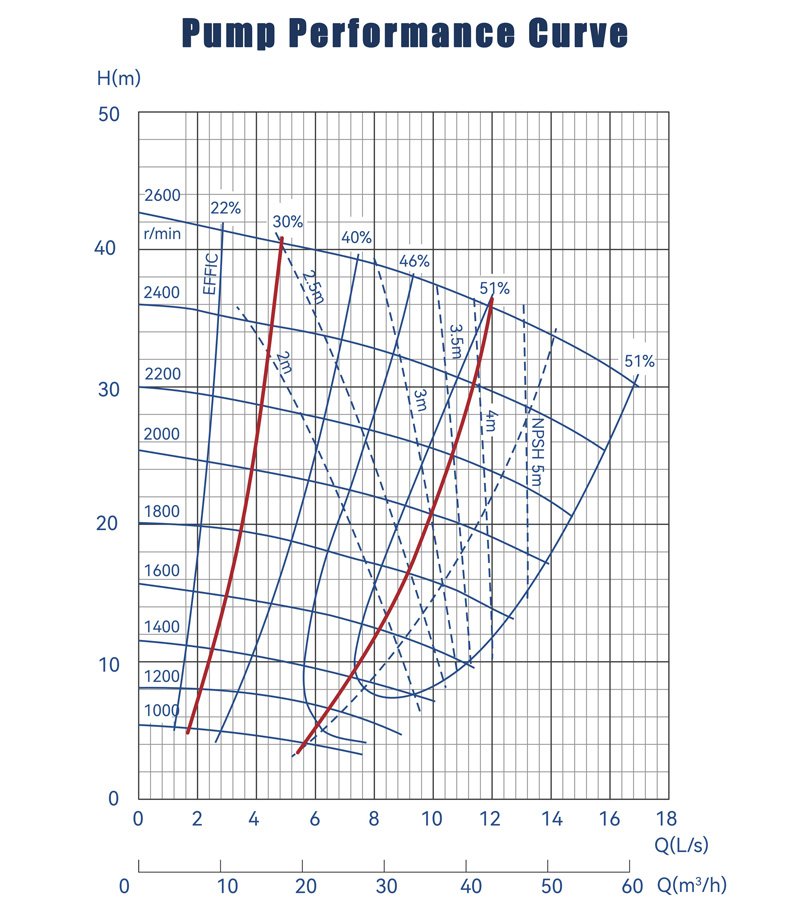
Choosing the right volute pump requires considering the characteristics of the medium being pumped, system requirements, and essential information such as flow rate, pump head, material, efficiency, and motor speed.
When selecting a pump model, we usually use the pump curve to determine the final pump specifications. The goal is to select the pump with the best efficiency to improve delivery efficiency and reduce energy consumption.
Flow
Flow rate is an important factor when selecting a pump. The flow rate determines the size of the pump inlet and outlet, the size of the impeller, and the operating point. Only after determining the flow rate can further decisions be made.
Head
The pump head represents the pressure required by the system, which is determined by the pump’s pressure performance and the system resistance.
Slurry
The characteristics of the pumped fluid are also an important factor in pump selection. For media such as slurry and wastewater, the solid content, particle size, viscosity, etc. need to be considered, as these all affect the selection of pump specifications such as flow rate, pressure, and materials.
Material
When selecting materials, it is necessary to choose appropriate materials based on the corrosiveness, temperature, and abrasiveness of the medium, such as ductile iron, stainless steel, high chromium alloy, rubber, ceramics, etc. Suitable materials can maximize the service life.
Efficiency
When selecting a model, you should choose the BEP (Best Efficiency Point) within the efficiency range. You should not blindly pursue high efficiency and make a selection that may result in high energy consumption or short service life.
Seal
The appropriate seal should be selected based on the medium being transported, and ease of maintenance and leakage issues should also be considered. Generally, there are mechanical seals and packing seals.
Speed
The motor speed affects efficiency, wear, and service life. Lower speeds result in less wear, but the final determination depends on the pump’s flow rate, head, and other specifications.
Why Choose Kingda Volute Pumps
Since 1948, Kingda has focused on the research and development and manufacturing of pumps. We possess a complete pump production chain, from the selection of casting materials and product design to the design of slurry transportation solutions, boasting rich experience and a long history.
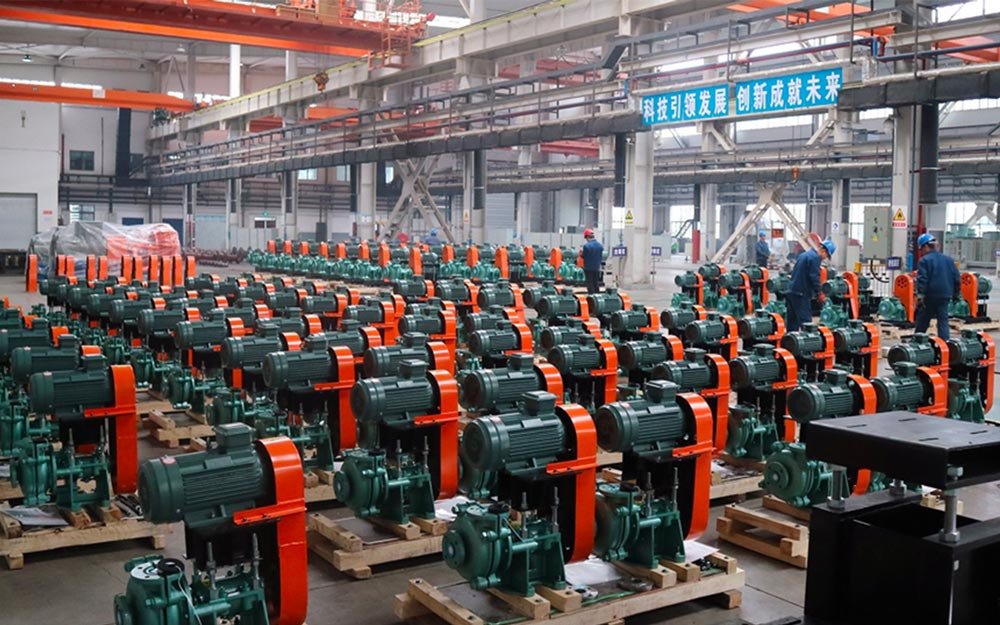
Our projects span the globe, involving 76 countries, including municipal water systems, large pumping stations, mines, dredging, TBMs, and power plants—wherever liquid flows, our presence can be found.
We also have a professional and knowledgeable maintenance team. When your pump products encounter any problems, they will provide you with fast and professional solutions immediately.
Frequently Asked Questions About Volute Pumps
What is the function of a volute in a pump?
The main function of a volute is to guide the flow of liquid, convert some of the liquid’s kinetic energy into pressure energy, and reduce the hydraulic loss of the liquid.
Why is a volute casing used in a centrifugal pump?
The working principle of a centrifugal pump is that the impeller rotates to generate centrifugal force, which draws in liquid and throws it in all directions. The spiral volute can better withstand the impact of increasingly large liquid flow and reduce the velocity of the liquid continuously flowing into the volute, thus maintaining a stable flow rate and providing better pressure output.
What is the difference between a volute pump and a centrifugal pump?
A volute pump is actually a centrifugal pump. The volute is an essential component of a centrifugal pump; it is the container that holds the impeller.
What is a double volute pump and when is it used?
The double volute pump features a double-shell design, which effectively reduces radial load and improves stability. It is suitable for high-pressure, high-flow environments, such as large pumping stations, irrigation systems, and mines.
Are volute pumps suitable for slurry applications?
Volute pumps are suitable for slurry applications because they have a simple structure, high efficiency, and the materials used can be selected based on the medium. These materials are wear-resistant and corrosion-resistant, such as high-chromium alloys, stainless steel, and rubber, which can effectively reduce the scouring and friction damage caused by slurry.
What materials are commonly used for volute pump casings?
Ductile iron, stainless steel, elastic rubber, ceramics, and high-chromium alloys are commonly used materials for volute pump casings.
How can the service life of a volute pump be improved?
The best way to extend the lifespan of a volute pump is to choose the appropriate model, followed by regular and professional maintenance during daily use.
Can Kingda provide customized volute pumps and replacement parts?
Sure, Kingda can provide custom volute pumps and replacement parts. Kingda can also customize professional fluid transfer solutions according to customers’ transfer environments.